
It’s the first real decision most homeowners face when planning a home theater, and it shapes nearly every choice that follows — room lighting, seating distance, even acoustic treatment. Neither option is universally better; each wins decisively in a different kind of room.
The Case for a 4K Laser Projector
Screen Size, Image Quality, and Ambiance
A 4K laser projector’s biggest advantage is scale. Where large-format TVs become dramatically more expensive past 85–98 inches, a projector delivers a 100, 120, or even 150-inch image at a cost per inch that stays far more reasonable as size increases. For homeowners chasing genuine cinema scale, projection is the only practical path.
Laser light sources — now standard on quality residential projectors — have largely solved the maintenance and brightness-degradation issues that plagued older lamp-based projectors, delivering consistent brightness for 20,000+ hours with no bulb replacements. Combined with a proper acoustic-transparent screen and a fully dark room, a well-installed laser projector produces an image quality and sense of scale that a TV, at any size, can’t fully replicate.
Screen selection matters as much as the projector itself. An acoustic-transparent screen — perforated to let sound pass through from speakers mounted directly behind it — allows the center channel and front speakers to sit exactly where the dialogue appears to originate on screen, rather than being pushed off to the sides. This is a meaningful upgrade over a standard opaque screen for anyone building a genuinely high-performance theater, and it’s a detail that’s easy to overlook when comparing projectors purely on brightness and resolution specs.
The trade-off is environmental control. Projectors need a dark room to perform at their best — any meaningful ambient light washes out contrast and color saturation, which is why projector-based theaters are almost always paired with full blackout shading and minimal or fully controllable ambient lighting.
The Case for a Large-Format TV
Brightness, Simplicity, and No Screen Required
Large-format TVs — now widely available up to 98 inches, with even larger sizes becoming more accessible — offer a fundamentally different trade-off: significantly higher peak brightness, which means they perform well even with some ambient light in the room, and self-contained simplicity with no separate screen, ceiling mount, or throw-distance calculation required.
Modern large-format TVs, particularly those using Mini-LED or OLED panel technology, also deliver deeper black levels and higher contrast in a fully dark room than most projectors can match, alongside HDR performance that takes advantage of the panel’s higher peak brightness. Mini-LED panels use localized backlight dimming zones to boost brightness and contrast simultaneously, while OLED panels achieve near-perfect black levels through self-emissive pixels that turn off completely rather than being dimmed by a backlight — both approaches outperform projection specifically on HDR highlight detail, where a projector’s more limited peak brightness shows its clearest disadvantage. For a multi-purpose media room that also needs to function well during the day, or a room that can’t achieve full blackout conditions, a large-format TV is often the more practical choice.
The trade-off is cost scaling with size. Once you move into 85″+ territory, large-format TV pricing increases sharply, and it becomes genuinely difficult to match a projector’s sense of scale at a comparable price point.
Can You Have Both?
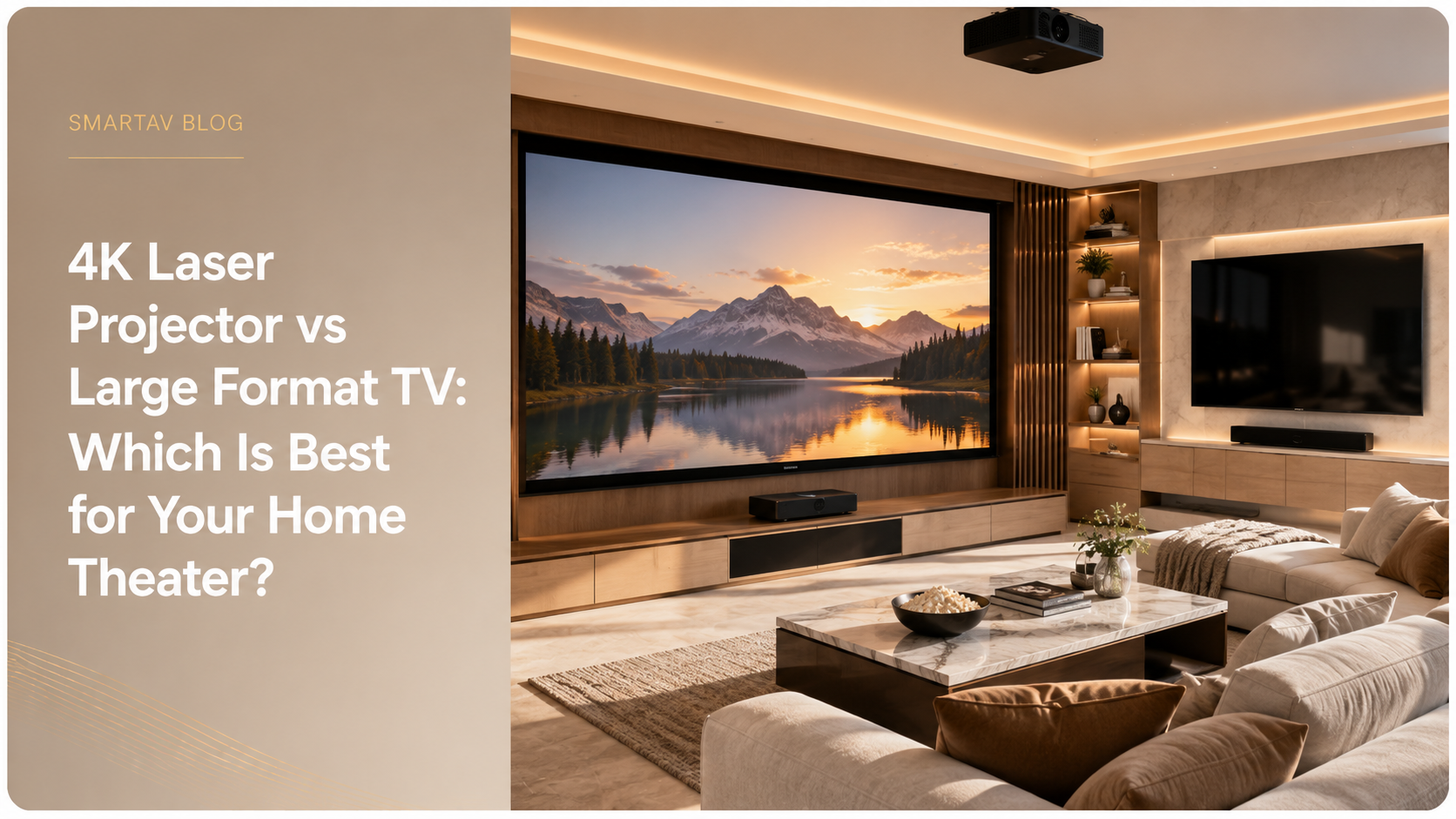
For homeowners who can’t decide, a growing number of GTA theater rooms use a hybrid approach: a large-format TV for daytime use, casual viewing, and sports, paired with a retractable or motorized projector screen that drops down in front of it for movie nights. This isn’t a compromise so much as a genuine best-of-both-worlds setup for rooms with mixed use cases — the TV handles bright-room, everyday viewing, while the projector delivers full cinema scale when the room is properly darkened for a dedicated movie session.
The added cost is real — essentially budgeting for both display technologies rather than choosing one — but for a primary family room that also serves as the home’s main theater space, it solves the ambient-light problem that would otherwise force a compromise on either technology alone.
Room Requirements Comparison
| Factor | 4K Laser Projector | Large-Format TV |
|---|---|---|
| Ambient light tolerance | Low — needs a dark room | High — performs well with some ambient light |
| Practical max screen size | 100–150″+ | Currently up to ~98″ at reasonable cost |
| Installation complexity | Higher — throw distance, screen, mounting | Lower — largely self-contained |
| Ideal room type | Dedicated, light-controlled theater | Media room, multi-purpose space |
| Peak brightness | Lower, room-dependent | Significantly higher |
| Black level / contrast (dark room) | Strong with proper screen | Excellent, especially OLED |
Cost Comparison: Total Installed Price
| Setup | Typical Installed Cost (Toronto, 2026, CAD) |
|---|---|
| Entry 4K laser projector + fixed screen | $6,000–$12,000 |
| Mid-range 4K laser projector + acoustic-transparent screen + mounting | $15,000–$30,000 |
| Premium 4K laser projector + motorized screen + full calibration | $30,000–$60,000+ |
| 75–85″ large-format TV, mounted and calibrated | $5,000–$15,000 |
| 98″ large-format TV, mounted and calibrated | $25,000–$45,000+ |
These figures include the display itself, professional mounting, calibration, and integration into the room’s automation system. They don’t include acoustic treatment, seating, or the AV receiver and speaker system, which are typically quoted separately.
→ Related: For the full picture of home theater design decisions beyond the screen, see How to Design a Home Theater Room: A Complete Guide for Toronto Homeowners
What Toronto Homeowners Are Choosing in 2026
For dedicated, purpose-built theater rooms — typically finished basements with full light control — 4K laser projectors remain the more common choice among SmartAV’s Toronto projects, largely because these rooms are already designed around achieving a dark environment, which plays directly to projection’s strengths.
For media rooms and family spaces that need to function well during the day — a walkout basement with windows, or a great room that occasionally doubles as a viewing space — large-format TVs, particularly in the 77–85″ range, have become the more practical and increasingly popular choice, helped by falling prices at those sizes over the past several product generations.
SmartAV note: The room usually answers this question before the homeowner’s preference does. If a space can achieve genuine blackout conditions and is used primarily for movie nights, projection almost always wins on value and scale. If the room has any daytime use or can’t be fully darkened, a large-format TV consistently delivers the better real-world experience.
Frequently Asked Questions
Can a projector work in a room with some ambient light?
Not well. Even moderate ambient light significantly reduces perceived contrast and color saturation on a projected image. Ultra-short-throw projectors paired with ambient-light-rejecting screens can mitigate this somewhat, but a large-format TV remains the more reliable choice for rooms without full light control.
Do laser projectors need bulb replacements like older projectors?
No — laser light sources are rated for 20,000+ hours of use, typically outlasting the projector’s practical service life before any light source maintenance is needed, unlike older lamp-based projectors that required replacement bulbs every 2,000–5,000 hours.
Is a projector or TV better for watching sports?
Large-format TVs generally have an edge for sports viewing specifically, thanks to higher peak brightness (useful in rooms with some daytime light) and typically lower input lag and better motion handling for fast-moving content.
How far should seating be from a projector screen?
For a 4K projector image, seating distance of roughly 1.5 to 2.5 times the screen’s diagonal size generally produces the best balance of detail and immersion — closer than that risks seeing individual pixels; farther reduces the sense of scale.
Which option holds up better over time?
Both technologies have improved significantly in reliability. Laser projectors eliminate the bulb-replacement maintenance older projectors required, while large-format TV panel technology (particularly OLED) has addressed earlier concerns about burn-in with modern pixel-shifting and screen-saver features. Either option, properly installed, should perform well for a decade or more.
Does 8K resolution matter for either option yet?
Not meaningfully for most home theater applications in 2026. Native 8K content remains scarce, and at typical home theater viewing distances, the resolution difference between well-implemented 4K and 8K is difficult to perceive. Investing in the best available 4K display and proper calibration currently delivers more real-world benefit than prioritizing 8K resolution alone.
Get a Home Theater Recommendation
SmartAV can help you decide between a projector and a large-format TV based on your specific room, budget, and how you’ll actually use the space.
Get a home theater recommendation →
📞 (416) 904-0504