
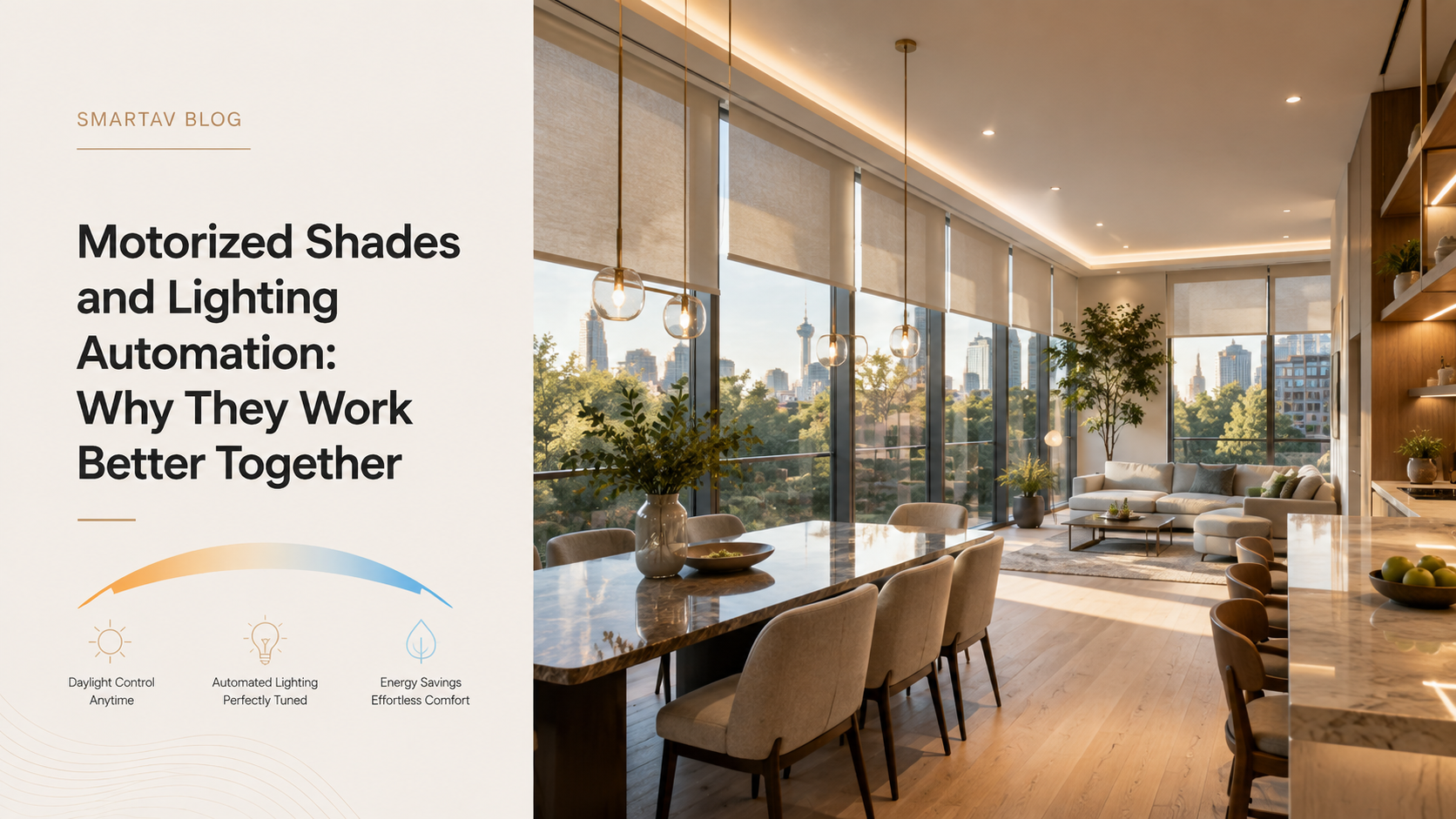
Homeowners often approach motorized shades and smart lighting as two separate purchases — a shading upgrade here, a lighting project there. Treated separately, both work fine on their own. Programmed together as a single system, they solve problems neither one can address alone: managing the total light in a room, both natural and artificial, throughout the day.
The Problem With Controlling Shades and Lighting Separately
A home with automated shades but standard lighting still requires manual adjustment every time the sun moves — lights that don’t compensate as afternoon glare hits a west-facing window, or a room that goes dim the moment the shades close for privacy with no corresponding light increase. The reverse is just as common: lighting that’s scheduled independently of what the shades are actually doing, burning energy on artificial light in a room that’s getting plenty of natural daylight.
Neither system, working in isolation, actually solves the underlying problem: managing the total light in a space. That requires both working from the same logic.
How Integrated Shade + Lighting Scenes Work
When shades and lighting are programmed as one system, scenes can respond to natural light conditions and time of day together, rather than each system running its own separate logic:
- “Good Morning” — Shades raise partway while lighting ramps up gradually, easing a bedroom from dark to bright rather than an abrupt full-brightness switch-on
- “Bright Work” — Shades open fully for maximum daylight in a home office, with lighting supplementing only where natural light doesn’t reach
- “Privacy” — Shades close for evening privacy, with lighting automatically compensating so the room doesn’t suddenly feel dim
- “Peak Sun” — During Toronto’s intense afternoon summer sun, south- and west-facing shades close automatically to reduce glare and solar heat gain, without needing anyone to notice and react
This is the core advantage of integration: the system responds to actual conditions — sun position, time of day, season — rather than running two independent schedules that happen to overlap.
→ Related: See the full Lutron shading and lighting lineup in Lutron Lighting Control: Complete Guide for Toronto Homeowners
Energy Savings From Combined Automation
The energy case for integrated shade and lighting control is stronger than either system delivers alone. Automated shades that respond to sun position reduce solar heat gain during Toronto’s hot, humid summer afternoons — directly lowering air conditioning load during peak-price hours. In winter, the same system can allow more solar gain during sunny days to offset heating costs, then close at night to reduce heat loss through windows.
Layered with lighting that only supplements natural daylight rather than running on a fixed schedule regardless of conditions, the combined effect measurably outperforms either system’s savings in isolation. Lutron’s own research has found that coordinated shading can reduce a home’s cooling load by up to 40% during summer peak hours — a meaningful number for Toronto homes with large or south-facing window exposure.
Lutron’s Total Home Control Approach
Lutron designed its lighting and shading product lines to function as a single system from the start, rather than as separate products that happen to share a brand. Both RadioRA 3 and Homeworks QSX support shading and lighting devices on the same processor, programmed through the same scene architecture — there’s no separate shading “app” or control layer bolted on afterward.
This matters practically: a homeowner adding motorized shades to an existing Lutron lighting system isn’t starting a second project from scratch. The shades integrate into the same keypads, the same app, and the same scenes already governing the home’s lighting.
SmartAV note: The most common mistake we see is homeowners installing shades and lighting as two separate projects, sometimes years apart, without planning for them to work together. It’s not usually difficult to combine them after the fact, but designing both systems together from the start produces meaningfully better scenes and avoids paying twice for overlapping programming work.
→ Related: For the full comparison of Lutron’s two whole-home platforms, see Lutron Homeworks QSX vs RadioRA 3: Which System Do You Actually Need?
Installation Considerations for New and Existing Homes
New construction offers the most flexibility — shade motor wiring, lighting circuits, and processor placement can all be planned together during framing, at a fraction of the cost of adding either system after the home is finished.
Existing homes can still achieve full integration, particularly with Lutron’s wireless RadioRA 3 platform, where shades and lighting both communicate over RF rather than requiring extensive new wiring. This makes combined shade-and-light automation a realistic retrofit project for most Toronto homes, not just new builds.
Room-by-room versus whole-home is worth deciding upfront. Starting with a single high-impact room — a primary bedroom or main living space with significant window exposure — lets homeowners experience integrated control before committing to a whole-home rollout, and a well-designed system can expand cleanly later without reprogramming what’s already in place.
A Typical GTA Scenario
Consider a common case: a 3,500 sq ft home in Oakville with a south-facing great room, floor-to-ceiling windows, and existing RadioRA 3 lighting installed during a kitchen renovation two years ago. Adding motorized Sivoia QS shades to that room doesn’t require touching the existing lighting processor — the shades join the same system, and a new “Afternoon Sun” scene can be built that closes the shades partway and nudges up ambient lighting to compensate, all without re-programming anything already in place. This kind of incremental addition is the norm, not the exception, for homes that started with Lutron lighting first.
Frequently Asked Questions
Do motorized shades and lighting need to be the same brand to integrate?
Not necessarily, but same-brand systems — particularly Lutron’s Sivoia QS and Palladiom shading lines paired with RadioRA 3 or Homeworks QSX lighting — integrate most seamlessly, since they’re designed from the ground up to share the same processor and scene architecture. Mixed-brand setups are possible but typically require additional integration work.
Can I add motorized shades to a home that already has Lutron lighting?
Yes — this is one of the most common upgrade paths we see. If the home already runs RadioRA 3 or Homeworks QSX, adding compatible shading typically integrates directly into the existing keypads and scenes without needing to rebuild the lighting system.
How much do integrated shade and lighting systems cost?
Costs vary significantly by home size and window count, but combining both into a single Lutron system is generally more cost-effective than installing them as two fully separate projects with duplicated programming work. Your integrator can provide a combined quote once window count and lighting scope are known.
Will automated shades work during a power outage?
Motorized shades typically stop functioning during a power outage unless the system includes battery backup, which is available for most Lutron shading lines. Lighting keypads retain their programming and resume normal operation once power is restored.
Do I need to replace my existing blinds to add motorized shades?
In most cases, yes — motorized shades use purpose-built hardware rather than retrofitting existing manual blinds, though the existing window treatments can sometimes inform fabric and style choices for the replacement.
The Takeaway
Motorized shades and smart lighting each deliver real value on their own, but the combination — one system managing all the light in a space, natural and artificial together — is where the actual comfort and energy benefits show up. For homeowners planning either upgrade, it’s worth designing both as one project from the start.
Design Your Integrated Lighting and Shade System
SmartAV designs combined lighting and shading systems for Toronto homes, whether you’re starting from scratch or adding shades to an existing Lutron lighting setup.
Design your integrated system →
📞 (416) 904-0504