
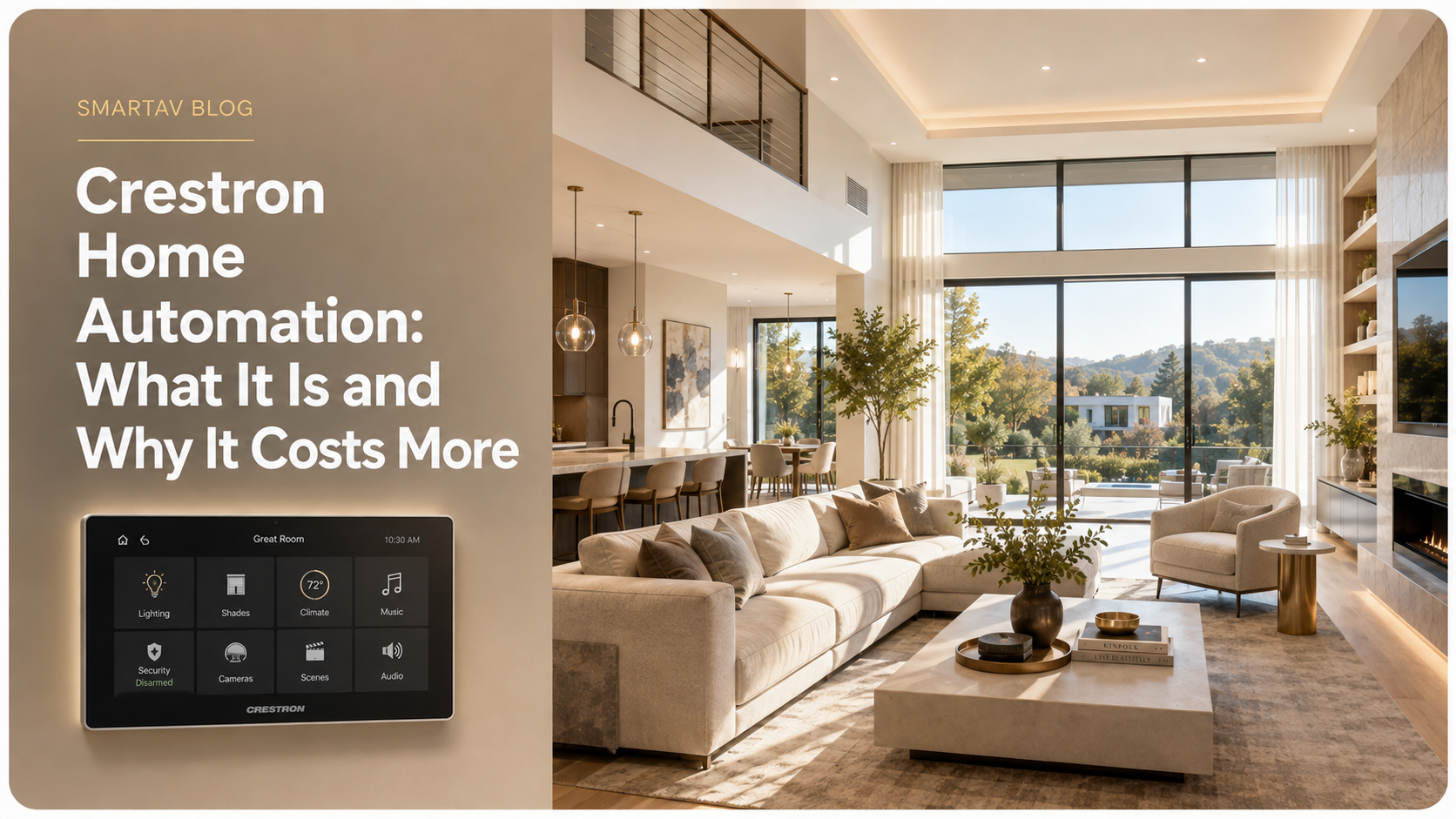
Ask around in Toronto’s luxury home market and Crestron comes up constantly — usually alongside a number that makes homeowners pause. It’s the platform architects and designers reach for on the largest, most complex projects in the GTA, and it consistently carries the highest price tag of any residential automation system.
This guide explains what Crestron actually is, what separates it from other platforms, and why the cost difference is real rather than just brand premium.
What Crestron Is (and Isn’t)
Crestron Electronics is a private, US-based company that’s been building automation and control systems since 1971 — originally for commercial and institutional environments (boardrooms, universities, government buildings) before expanding into residential. That commercial DNA still shapes the platform: Crestron is engineered for reliability and scale first, polish second, though its residential product line has closed much of that gap in recent years.
What Crestron is not is a consumer product. You can’t buy a Crestron processor at a retail store or self-install a system from a manual. Every Crestron project runs through a certified dealer, who designs, programs, and commissions the system. That’s a deliberate choice by Crestron to protect installation quality — and it’s part of why the platform costs what it does.
Crestron Home vs. Crestron Commercial
Crestron sells into two distinct markets with different product lines. Crestron Home is the residential platform: processors, touchscreens, and the Crestron Home app designed specifically for single-family houses and estates. Crestron’s commercial line — used for boardrooms, classrooms, and large facilities — shares underlying technology but is a separate product ecosystem with different hardware and different dealer certifications.
For homeowners, this distinction matters mainly in one way: a dealer certified for commercial Crestron installations isn’t automatically qualified to design a residential system, and vice versa. When vetting an installer, it’s worth confirming they hold Crestron Home certification specifically.
→ Related: For a full comparison against Control4 and Savant, see Crestron vs Control4 vs Savant: Which Smart Home Platform Is Right for You?
Key Crestron Features: Processor, Touchscreens, and App
The processor. Every Crestron system is built around a central processor that runs entirely locally — meaning core functions like lighting, climate, and AV control don’t depend on an internet connection or a cloud server to work. This is a meaningful reliability advantage over more cloud-dependent platforms, particularly for functions you rely on daily.
Touchscreens and keypads. Crestron’s in-wall touchscreens and tabletop panels are widely regarded as some of the most responsive and customizable control interfaces in the industry. Unlike generic tablets running a third-party app, Crestron touchscreens are purpose-built hardware, programmed specifically for the home’s layout and the homeowner’s actual routines.
The Crestron Home app. For day-to-day and remote control, the Crestron Home app runs on iOS and Android and mirrors the functionality of in-wall panels — lighting scenes, climate, shades, security, and AV, all from one interface. The app has been substantially refined over the past several product generations and now offers a genuinely polished user experience, closing a gap that used to favor competitors like Control4 and Savant.
What Crestron Integrates With
Crestron’s programming flexibility means it can integrate with an enormous range of third-party equipment — but unlike Control4’s plug-and-play driver library, Crestron integrations are typically custom-programmed by a certified dealer for each project. This is both a strength and a cost driver: it means virtually anything can be integrated, but the integration work itself takes skilled programming time.
The most common and best-supported integrations include:
- Lutron Homeworks QSX — the deepest lighting integration available on any platform, communicating over a dedicated connection with millisecond response times
- Security and access control systems — cameras, alarms, and locks from most major professional-grade brands
- Climate control — multi-zone HVAC systems, particularly on larger homes with zoned heating and cooling
- AV distribution — matrix switching, multi-room audio, and home theater systems, an area where Crestron’s commercial-grade roots show clearly
→ Related: See how Crestron and Lutron work together in detail in Lutron Lighting Control: Complete Guide for Toronto Homeowners
What a Typical Crestron Project Actually Involves
Because every Crestron system is custom-programmed rather than built from off-the-shelf drivers, the process looks meaningfully different from installing a more templated platform:
Site survey and design. A certified dealer surveys the home, documents every room’s lighting, climate, and AV requirements, and maps out how the household actually wants to interact with the system — not a generic scene template, but scenes and automations built around the family’s real routines.
Infrastructure planning. For new construction, this happens alongside the electrical rough-in — structured wiring, equipment room location, and conduit runs are planned before drywall. For renovations, the same infrastructure decisions have to work within the existing structure, which is part of why retrofits cost more than new-build installations.
Custom programming. This is where Crestron’s cost and capability both come from. A certified programmer builds the system’s logic — how “Movie Night” ties lighting, shades, and AV together, how the home responds to occupancy and time of day, how each touchscreen and keypad is laid out — specifically for that home, rather than adapting a preset template.
Commissioning and training. Once programmed, the system is tested and fine-tuned in the actual space, then the household is walked through the interface and given documentation for future reference or service calls.
Why Crestron Costs More Than Other Platforms
The price difference between Crestron and platforms like Control4 isn’t marketing markup — it comes from several structural factors:
Custom programming, not driver installation. Where Control4 largely works by installing pre-built drivers for supported devices, a Crestron system is programmed from a more open toolset for each individual project. That flexibility is exactly what makes Crestron capable of handling estate-scale complexity, but it requires significantly more skilled labour hours per project.
Processor and hardware cost. Crestron processors, touchscreens, and keypads are commercial-grade hardware, built for a longer service life and higher reliability standard than consumer electronics — and priced accordingly.
Dealer certification requirements. Crestron maintains a tighter certification program than most competitors, requiring dealers to complete substantial technical training before they’re authorized to sell and program the platform. Fewer certified dealers per capita, doing more custom work per project, is reflected in the final price.
No DIY or self-install path. Unlike Caseta-tier lighting products or consumer smart home devices, there’s no lower-cost entry point to Crestron. Every project, regardless of size, goes through a full professional design and installation process.
SmartAV note: Homeowners sometimes assume Crestron’s cost comes from the brand name alone. In our experience specifying and installing both platforms, the price gap versus Control4 tracks fairly closely with the actual programming hours required — Crestron projects simply take a more custom approach at every stage.
What Does Crestron Cost in Toronto?
Crestron pricing scales with the scope of the project — a single home theater integration looks very different from a full-estate system spanning lighting, climate, security, and AV. Below are realistic installed price ranges for Toronto-area Crestron projects.
| Project Scope | Typical Installed Cost (Toronto, 2026, CAD) |
|---|---|
| Single-room AV or home theater integration | $8,000–$25,000 |
| Whole-home control (lighting, climate, shades) — 3,000–6,000 sq ft | $40,000–$90,000 |
| Full estate system with Homeworks QSX integration — 6,000–12,000 sq ft | $90,000–$250,000+ |
| Estate with extensive multi-zone AV, security, and outdoor integration | $150,000–$500,000+ |
These ranges include hardware, professional programming, and commissioning. They don’t include electrical rough-in work, structured wiring during construction, or third-party equipment like Lutron Homeworks QSX, which is typically quoted separately.
→ Related: For a full cost breakdown across every category of smart home project, see How Much Does a Smart Home Cost in Toronto? (2026 Complete Pricing Guide)
Is Crestron Right for Your Home?
Crestron makes the most sense in a specific set of circumstances:
- Large, complex estates — 8,000+ sq ft homes, multi-wing properties, or projects with extensive AV distribution across many zones
- New construction — where wiring and infrastructure can be planned in from the start, making full Crestron integration far more cost-effective than retrofitting
- Homes using Lutron Homeworks QSX — the two platforms’ integration is the deepest available on the market
- Homeowners who want maximum customization — scenes, automations, and interfaces tailored precisely to how the household actually lives, rather than working within a more templated system
For a typical 2,500–6,000 sq ft single-family home without estate-level complexity, Control4 usually delivers comparable day-to-day functionality at a meaningfully lower installed cost — worth a serious look before committing to Crestron by default.
→ Related: See where Control4 fits by comparison in Control4 Smart Home Review: Pros, Cons, and Real-World Performance
SmartAV as a Certified Crestron Dealer
SmartAV is a certified Crestron Home dealer serving Toronto and the GTA, with in-house programmers holding current Crestron certification. We specify Crestron on the projects where it’s genuinely the right fit — typically larger estates and new-construction homes — and we’re equally direct when a smaller project would be better served by Control4.
Frequently Asked Questions
Is Crestron better than Control4?
Neither is universally better — Crestron scales further and offers more customization for large, complex homes, while Control4 delivers excellent results at a lower cost for most mid-size homes. The right choice depends on your project’s scale and complexity.
Can I add Crestron to an existing home, or does it need new construction?
Crestron can be retrofitted into existing homes, but the cost is typically higher than a new-build installation, since wiring and infrastructure that would normally be planned in during construction need to be added afterward. For large renovations where walls are already open, retrofitting is far more practical.
Does Crestron require a monthly subscription?
No. Crestron’s core functionality — lighting, climate, shades, and AV control — runs locally on the processor with no required subscription. Certain optional cloud-connected features may have associated costs, which your dealer can outline for your specific system.
How long does a Crestron installation take?
Timelines vary significantly by project scope. A single-room AV integration might take a few days, while a full estate-level Crestron system with extensive lighting, climate, and AV integration can take several weeks of programming and commissioning, in addition to the physical installation.
What happens if my Crestron dealer is no longer available?
Because Crestron maintains a large, established certified dealer network, most Crestron systems can be serviced or taken over by another certified dealer if needed — though system documentation from the original installer makes this transition significantly smoother, which is why SmartAV provides full documentation on every project.
Talk to a Certified Crestron Dealer in Toronto
If you’re weighing Crestron for a new build, renovation, or estate project, SmartAV can walk through your home and give you a straight answer on whether it’s the right platform — or whether Control4 would serve you just as well at a lower cost.
📞 (416) 904-0504