
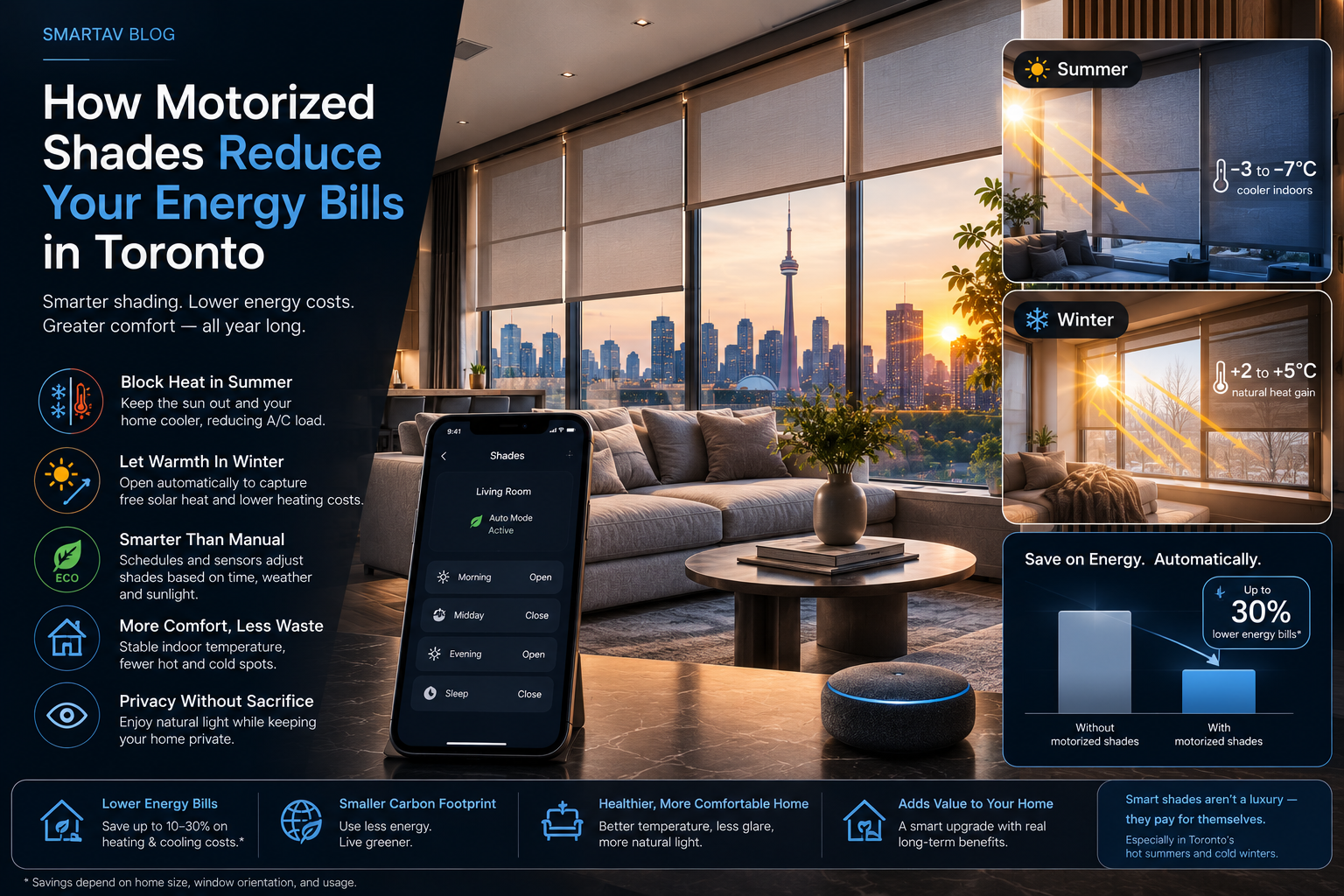
“Do motorized shades actually save money, or is that just a nice side benefit installers mention?” It’s a fair question, and the honest answer is: it depends on how the shades are used. A shade that’s manually operated once in a while delivers a fraction of the savings of the same shade on an automated schedule responding to actual sun position throughout the day. The mechanism, and the real numbers behind it, are worth understanding before deciding whether the investment makes sense for your home.
Solar Heat Gain and Why It Matters
Solar heat gain is the technical term for how much heat enters a home through windows via direct sunlight — and in a typical home, windows are one of the largest sources of unwanted heat gain during summer and unwanted heat loss during winter. A large south- or west-facing window can add a meaningful load to an air conditioning system during Toronto’s hot, increasingly humid summer afternoons, well beyond what the same square footage of insulated wall would contribute.
Modern GTA construction trends make this more relevant than it might have been a generation ago. Open-concept designs with expansive window walls — increasingly common in new-build homes across Oakville, Markham, and infill construction throughout Toronto proper — trade thermal efficiency for natural light and views, which shifts more of a home’s total heat gain and loss burden onto glass rather than insulated wall. That trade-off is a reasonable design choice, but it makes managing solar exposure through shading meaningfully more consequential than in an older home with smaller, more traditional window openings.
This is the physical mechanism motorized shades address directly: by blocking direct sun exposure specifically during peak heat-gain hours, shades reduce the cooling load on a home’s HVAC system before that heat ever has a chance to accumulate indoors.
How Automated Shades Cut Cooling Costs in Summer
The key word is automated. A shade that’s manually closed only when someone happens to notice the room getting warm misses most of the actual peak sun exposure — by the time it’s uncomfortable enough to notice, a meaningful amount of heat has already been absorbed by furniture, flooring, and walls, where it continues radiating into the room for hours afterward.
An automated system, by contrast, closes shades on a schedule tied to sun position and time of day — before peak exposure begins, not after it’s already noticeable. Lutron’s own published research has found that automated shading can reduce a home’s cooling load by up to 40% during summer peak hours on affected windows — a substantial number for homes with significant south- or west-facing glass, which describes a large share of newer GTA construction with open-concept, window-heavy designs.
Shade Automation for Toronto Winters
The same mechanism works in reverse during Toronto’s cold season, though the optimal strategy flips. During sunny winter days, allowing solar gain through south-facing windows can meaningfully offset heating costs — free solar heat that would otherwise require the furnace to generate. At night and on overcast days, closing shades reduces heat loss through the window, since glass (even well-insulated glass) loses heat faster than an insulated wall.
A properly programmed system distinguishes between these scenarios automatically — opening south-facing shades on a sunny January afternoon to capture solar heat, then closing them at sunset to reduce nighttime heat loss, all without anyone needing to think about it.
To make the seasonal logic concrete: a south-facing living room on a clear, cold January day might see the room’s south windows stay open through the shades from roughly 10am to 3pm, capturing the low winter sun angle’s heat directly, then close at sunset as outdoor temperatures drop further. The same windows on an overcast January day might stay closed throughout, since there’s no meaningful solar gain to capture and closing the shades reduces heat loss regardless of time of day. This is the kind of nuanced, conditional logic that’s impractical to manage manually but straightforward for an automated system with the right triggers configured.
Programming Shade Schedules and Triggers
Effective shade automation typically combines several types of triggers rather than relying on a single fixed schedule:
- Time-of-day scheduling — tied to actual sunrise and sunset for the home’s specific location, adjusting automatically through the seasons
- Sun position and orientation — south- and west-facing windows programmed differently than north-facing windows, which see minimal direct solar gain regardless of time of day
- Temperature-triggered adjustments — some systems can incorporate outdoor or indoor temperature data, closing shades more aggressively on unusually hot days
- Manual override — homeowners retain the ability to adjust or override automated schedules for specific rooms or occasions without disrupting the underlying automation
SmartAV note: The homes that see the biggest measurable difference are almost always ones with significant west-facing glass — afternoon sun through west windows is the single biggest driver of late-day cooling load in most Toronto homes, and it’s exactly the scenario automated shading addresses most directly.
Combining Shades With Climate Control
Shades deliver their largest energy impact when they’re programmed alongside — not independently of — a home’s climate control system. A coordinated system can adjust thermostat setpoints in tandem with shade position: allowing slightly more solar gain on a cool winter morning to reduce heating demand, or pre-cooling a room before shades close on a hot afternoon rather than reacting after the room has already warmed up.
→ Related: For the full picture of how shades and lighting work together as one system, see Motorized Shades and Lighting Automation: Why They Work Better Together
Payback Period: When Do Shades Pay for Themselves?
This is the number homeowners actually want, and it varies meaningfully based on window exposure, home size, and current energy costs. As a general framework:
| Factor | Impact on Payback Period |
|---|---|
| High west/south window exposure | Shorter payback — more solar gain to offset |
| Primarily north-facing windows | Longer payback — less direct sun to manage |
| Combined with climate control integration | Shorter payback — compounds savings |
| Standalone, non-automated shades | Longer payback — savings depend on manual use |
| Larger home with higher baseline cooling costs | Shorter payback — larger cooling load to reduce |
For homes with significant south- or west-facing glass, energy savings alone often aren’t the primary justification for the investment — comfort, UV protection for furnishings and flooring, and convenience typically weigh as heavily as the energy savings in a homeowner’s actual decision. Treating the energy savings as a genuine but secondary benefit, rather than the sole justification, tends to be the more realistic framing.
Worth noting too: UV protection carries its own economic value that’s easy to overlook in a pure energy-cost calculation. Direct sun exposure fades hardwood flooring, upholstery, and artwork over time — a cost that shows up as furniture and flooring replacement rather than a utility bill line item, but is a real expense automated shading helps avoid regardless of how the energy savings alone pencil out.
Frequently Asked Questions
Do motorized shades save more energy than manual shades used consistently?
In practice, yes — even a diligent homeowner using manual shades rarely matches the consistency of an automated schedule that responds to actual sun position throughout the day, every day, regardless of whether anyone’s home to operate them.
Which window orientations benefit most from automated shading?
South- and west-facing windows see the most direct solar heat gain and benefit most from automated shading. North-facing windows receive minimal direct sun and see a smaller energy benefit, though they still benefit from reduced heat loss in winter.
Does window film or tinting achieve a similar effect?
Window film reduces solar heat gain consistently but permanently, while automated shades allow the flexibility to permit solar gain when it’s beneficial (a sunny winter afternoon) and block it when it isn’t (a hot summer afternoon) — a meaningful difference in year-round performance versus a static solution.
Can I add shade automation to existing manual shades?
In most cases, existing shades need to be replaced with motorized versions rather than retrofitted, though the fabric and general aesthetic can often be matched closely if that’s a priority during the upgrade.
Does shade color or opacity affect how much energy is saved?
Yes — darker, more opaque, or reflective fabrics generally block more solar heat than light, sheer fabrics, though even lighter fabrics designed for glare reduction still provide a meaningful reduction in heat gain compared to no shading at all. Your installer can recommend fabric options that balance light filtering preferences against energy performance for specific rooms.
Add Motorized Shades to Your Home
SmartAV designs motorized shading systems programmed specifically around your home’s window exposure and climate control, not generic default schedules.
Add motorized shades to your home →
📞 (416) 904-0504