
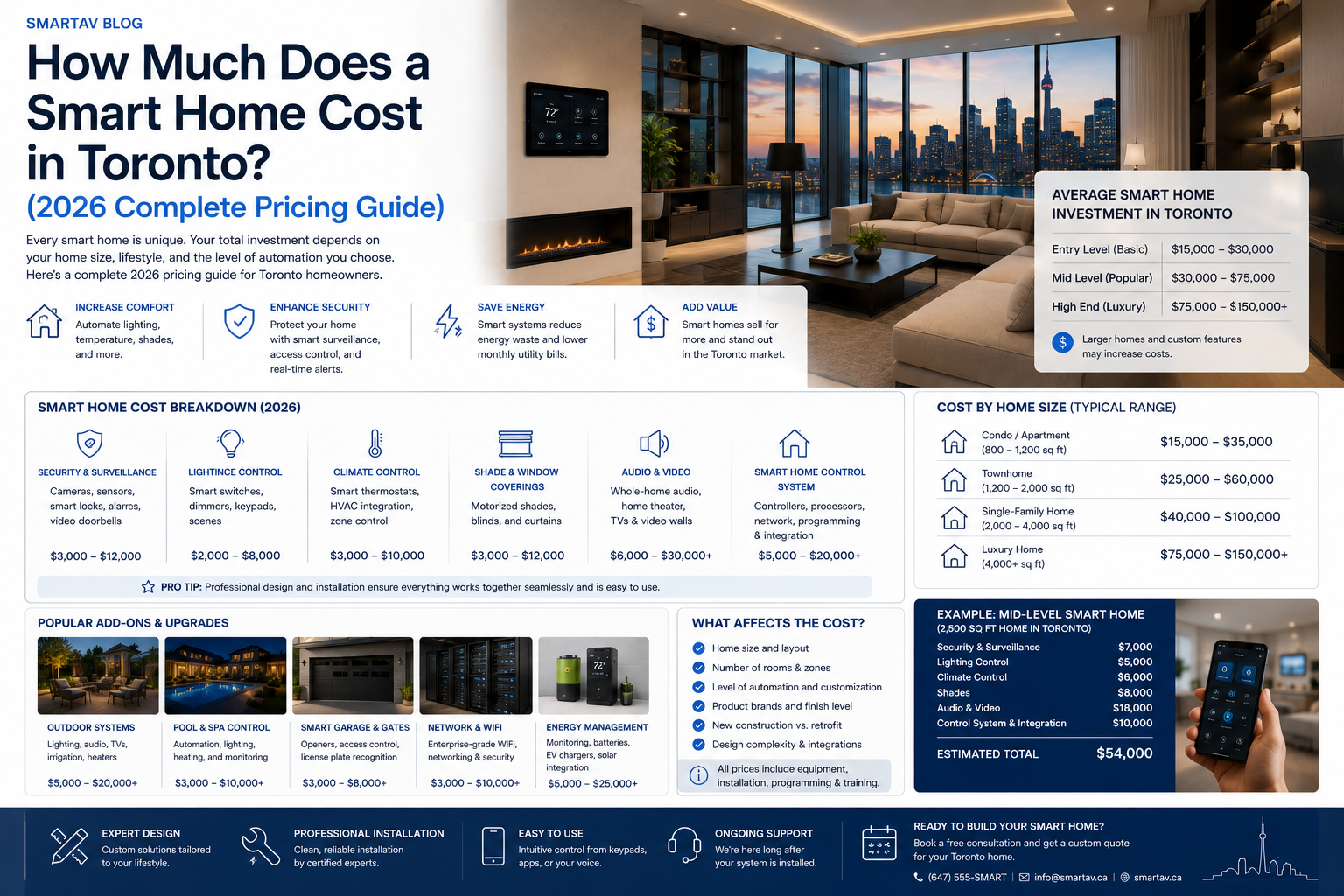
“How much does a smart home cost?” is one of the hardest questions to answer honestly, because the real range spans from a $10,000 lighting upgrade to a $500,000+ full estate automation project — and both are legitimately “a smart home.” This guide breaks that range into realistic tiers, shows what drives cost within each system category, and gives Toronto homeowners a framework for budgeting before getting quotes.
The most useful way to approach this question isn’t asking “what does a smart home cost” in the abstract, but “what does the specific set of systems I actually want cost, at the level of integration I actually need.” Two households with the same square footage and the same overall budget can end up in completely different places depending on whether they prioritize a small number of deeply integrated systems or a broader, lighter-touch automation across more categories.
Why Smart Home Costs Vary So Much
Unlike a kitchen renovation, where cost scales fairly predictably with square footage and finish level, smart home automation cost depends on which systems are included, how deeply they’re integrated with each other, and whether the platform is built for maximum customization (Crestron) or strong value at scale (Control4). Two homes of identical size can have automation budgets that differ by a factor of five or more, depending entirely on scope — a homeowner adding lighting control to three rooms and a homeowner building a full Crestron system with Homeworks QSX lighting, integrated shading, and a home theater are both “doing a smart home project,” just at completely different points on the spectrum.
Entry-Level Smart Home: $10,000–$30,000
At this tier, most homeowners are targeting a specific, high-impact upgrade rather than whole-home coverage: Lutron Caseta lighting in several key rooms, a handful of security cameras with AI detection, and perhaps a basic Sonos-based audio zone or two. This tier delivers genuine, noticeable improvement to daily life without the cost or commitment of a full whole-home system, and it’s a common and sensible starting point for homeowners who want to experience automation before committing to a larger project.
Example scope at this tier: Lutron Caseta dimming in a kitchen, living room, and primary bedroom; four exterior security cameras with AI detection and hybrid storage; a two-zone Sonos audio system covering the main living area and patio. A project like this typically lands in the $18,000–$24,000 range installed, depending on room count and specific equipment selections.
Mid-Range Smart Home: $30,000–$100,000
This is where most whole-home projects in the GTA actually land, and it typically includes a Control4 or RadioRA 3-based whole-home lighting and automation system, motorized shading in key rooms, a properly designed network with segmentation, and a mid-range home theater or media room setup. At this tier, systems genuinely work together — lighting, shades, and AV coordinated through one platform rather than operating as separate purchases.
Example scope at this tier: Whole-home Control4 with RadioRA 3 lighting across a 3,500 sq ft home; motorized shades in the primary living areas and bedrooms; a professionally designed network with VLAN segmentation; a mid-range home theater with 7.1.4 Atmos audio and a large-format display. A project of this scope typically lands in the $65,000–$85,000 range depending on window count, theater specification, and shade coverage.
Full Luxury Automation: $100,000–$500,000+
At the top tier, cost is driven by scale and customization more than any single component: Crestron with Homeworks QSX estate-wide lighting, a fully treated dedicated theater with premium Atmos configuration, comprehensive security with active deterrence, extensive outdoor integration, and custom programming tailored to exactly how a household lives. Projects at this level are almost always tied to new construction or a full architectural renovation, where automation is planned alongside the home’s design rather than retrofitted afterward.
Example scope at this tier: A 10,000 sq ft estate with full Crestron and Homeworks QSX integration across every room; Palladiom motorized shading throughout; a luxury dedicated cinema with premium laser projection and 9.1.6 Atmos; full property security with active deterrence at multiple entry points; and extensive outdoor audio, lighting, and integration across the property. Projects of this scope commonly land between $220,000 and $380,000, with the widest variation driven by theater specification and total lighting/shading zone count.
Cost Breakdown by System Type
Rather than one blended number, it’s more useful to understand realistic ranges by category — most whole-home projects combine several of these.
| System Category | Typical Installed Cost (Toronto, 2026, CAD) |
|---|---|
| Lutron lighting (Caseta to Homeworks QSX) | $800 – $150,000+ |
| Whole-home automation platform (Control4/Crestron) | $5,000 – $250,000+ |
| Motorized shading | $2,500 – $100,000+ |
| Home theater | $15,000 – $150,000+ |
| Home networking | $2,500 – $25,000+ |
| Security and surveillance | $3,500 – $45,000+ |
| Access control | $2,000 – $15,000+ (residential) |
| Outdoor audio and lighting | $3,000 – $60,000+ |
→ Related: For the full breakdown of the Crestron vs. Control4 decision that drives much of this cost range, see Crestron vs Control4 vs Savant: Which Smart Home Platform Is Right for You?
→ Related: For a detailed home theater cost breakdown specifically, see How Much Does a Home Theater Cost in Toronto? (2026 Pricing Guide)
Costs That Are Easy to Miss When Budgeting
A few line items consistently catch homeowners off guard when comparing quotes or planning a budget:
Electrical and infrastructure prep. Dedicated circuits, panel capacity upgrades, and structured wiring aren’t always included in an AV or automation quote — confirm whether electrical work is part of the scope or a separate line item handled by a different contractor.
Network infrastructure. A whole-home automation system depends on a properly designed network to function reliably, and this is sometimes quoted separately from the automation system itself rather than bundled as one project.
Third-party product costs. Lutron lighting, Sonos or Episode audio, and other third-party equipment integrated into a Crestron or Control4 system are sometimes quoted separately from the core automation platform, which can make quotes harder to compare directly unless every line item is itemized clearly.
Ongoing service and support. Some integrators include a service warranty period in the initial quote; others bill support calls separately after a shorter initial warranty. Confirm what’s covered and for how long before comparing a lower quote against a higher one that includes more ongoing support.
Content and programming depth. The difference between a system running default factory scenes and one genuinely programmed around how a household lives is almost entirely labour cost — a meaningful, sometimes underestimated, portion of a well-executed project’s total price.
New Build vs. Retrofit Cost Difference
This is the single biggest cost multiplier that has nothing to do with brand or product tier: the same specification, planned into new construction versus retrofitted into a finished home, can differ in cost by 30-60% or more.
New construction allows wiring, equipment locations, and conduit runs to be planned alongside standard electrical during framing — the incremental cost of adding structured cabling for a whole-home system during a stage when walls are already open is dramatically lower than opening finished walls later.
Retrofit projects into existing homes can absolutely achieve the same end result, but wireless-first systems (Lutron RadioRA 3, for instance, over wired Homeworks QSX) and careful planning around existing wall and ceiling access become more important considerations, since running new wiring through finished walls adds real labour cost.
SmartAV note: We always ask homeowners planning a renovation to loop us in during the design phase, even if they’re not ready to commit to a full automation budget yet. Reserving the right conduit paths and equipment space costs almost nothing at that stage and saves significantly if the project scope grows later.
Financing Options
Smart home projects at the mid-range and luxury tiers represent a significant investment, and several approaches can make the cost more manageable:
- Phased installation — implementing a system in stages (lighting first, then shading, then a theater) rather than as one large upfront project, spreading cost over time while still working toward a fully integrated end result
- Renovation or construction financing — for projects tied to a broader renovation or new build, automation costs are often included in the same financing as the rest of the construction project
- Manufacturer and dealer financing programs — some platforms and dealers offer financing options specifically for smart home projects, worth asking about during the quoting process
- Prioritizing highest-impact systems first — starting with the category delivering the most immediate value (often lighting or security) and expanding over subsequent years as budget allows
What Actually Drives Cost Within Each Tier
A few factors consistently explain why two projects of similar scope can land at meaningfully different price points:
Platform choice. Crestron generally costs more than Control4 for comparable functionality, due to custom programming versus driver-based integration — a decision covered in detail in our platform comparison guide.
Wired vs. wireless infrastructure. Wired systems (Homeworks QSX, hardwired shade motors) cost more upfront than wireless equivalents but offer greater reliability and scalability — a trade-off that makes more sense in new construction than in a light retrofit.
Integration depth. A collection of individually purchased smart devices costs less than a professionally integrated system where lighting, shades, climate, and security are coordinated through one platform — but delivers a meaningfully different day-to-day experience.
Programming and design labour. This is the least visible cost driver and often the most significant differentiator between quotes — the actual hours spent designing scenes, testing integrations, and calibrating a system specifically for how a household lives, versus a quick default-scene setup.
SmartAV’s Project Process and Warranty
Every SmartAV project starts with an in-home consultation to understand the space and how the household actually wants to use it, followed by a detailed, itemized proposal before any equipment is ordered — so homeowners know exactly what they’re paying for at each stage. Installation includes full system programming, calibration in the finished space, homeowner training, and our standard parts and labour warranty, with ongoing support available for the life of the system.
Frequently Asked Questions
What’s a realistic starting budget for a first smart home project?
For homeowners testing the waters, $10,000–$20,000 typically covers a meaningful lighting upgrade in key rooms plus basic security cameras — enough to experience genuine automation before committing to a larger whole-home investment.
Does a bigger home always mean a bigger smart home budget?
Generally yes, since more rooms and more windows mean more devices, but the relationship isn’t perfectly linear — a smaller home with an extensive wish list (full theater, elaborate shading, estate-level lighting) can easily exceed the budget of a larger home with a more modest, targeted automation scope.
Is it cheaper to do everything at once, or phase the project over time?
Doing everything at once generally reduces total labour cost, since design and programming work can be planned holistically rather than revisited for each phase. That said, phasing remains a completely reasonable approach for managing cash flow, provided the initial phase is designed with future expansion in mind rather than requiring rework later.
How accurate are online smart home cost calculators?
Generally not very — smart home cost depends heavily on home-specific factors (existing wiring, wall construction, window count, platform choice) that a generic calculator can’t account for. An in-home consultation with a specific quote is a far more reliable way to budget than a generic online estimate.
Do smart home systems increase home value enough to offset their cost?
Well-integrated systems, particularly lighting and shading infrastructure, are increasingly recognized by GTA buyers and agents as genuine value-adds rather than gadgets — though the direct dollar-for-dollar resale return varies by system type and shouldn’t be the sole justification for the investment.
Get a Custom Smart Home Quote
SmartAV provides detailed, itemized quotes for Toronto smart home projects at every budget tier, from a single-room lighting upgrade to full luxury estate automation.
Get a custom smart home quote →
📞 (416) 904-0504