
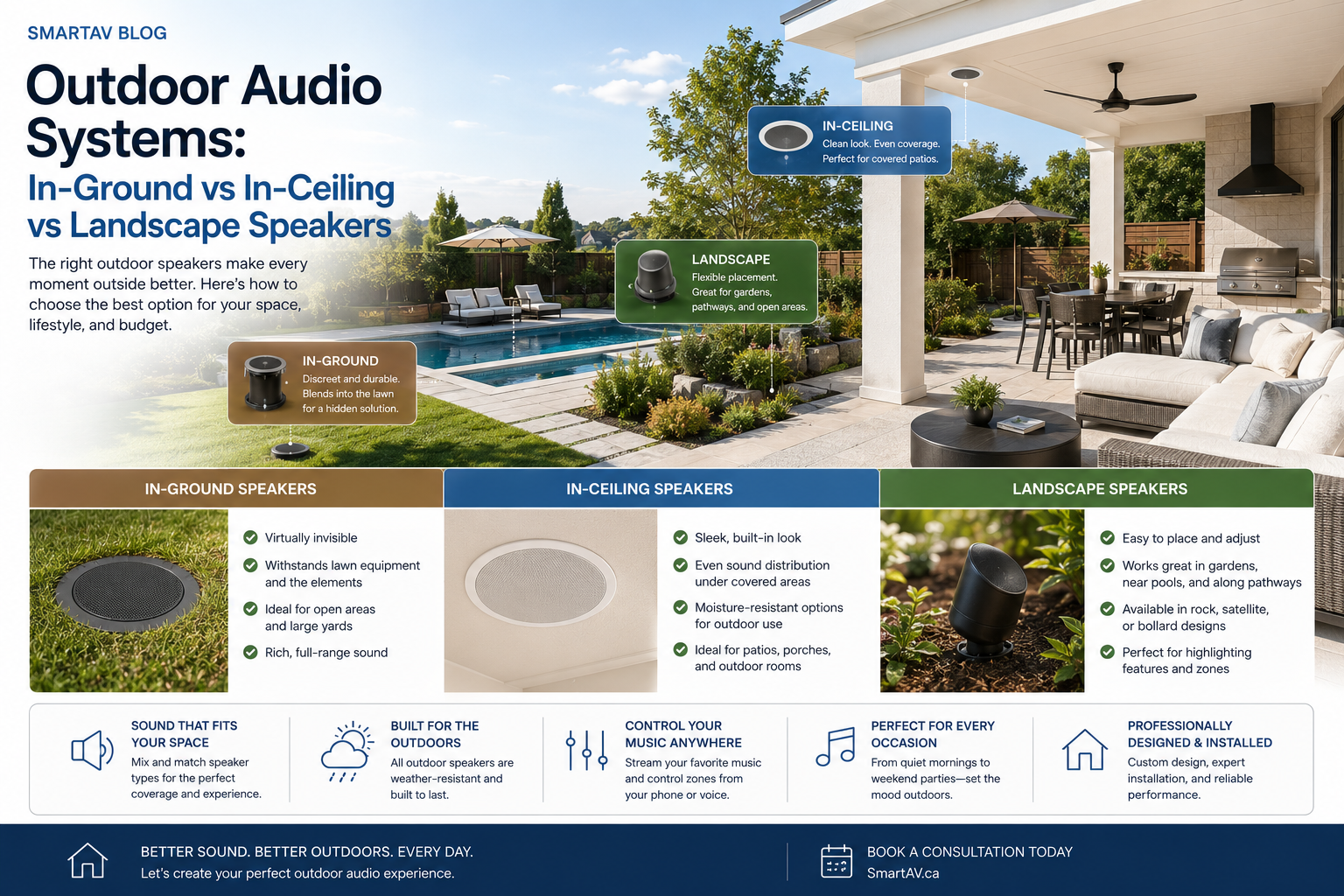
Three fundamentally different speaker types cover most outdoor audio scenarios, and the right choice usually isn’t a matter of preference — it’s determined by whether the area has a ceiling, how visible you want equipment to be, and how much bass performance actually matters for the space. Here’s how each type performs and where it genuinely makes sense.
The Three Types of Outdoor Speakers
In-ground speakers are installed flush with the lawn or garden surface, completely invisible when not in use and virtually invisible even when playing. In-ceiling outdoor speakers mount into the ceiling of a covered porch, patio, or pergola, similar to indoor in-ceiling installations but built with weatherproof components. Landscape (or “rock”) speakers sit above ground, disguised as rocks, planters, or other garden elements, offering more flexibility in placement without requiring a ceiling or in-ground installation.
Each type solves a genuinely different problem, which is why most well-designed outdoor systems mix more than one type rather than committing to a single approach across an entire property. The decision usually starts with a simple site assessment question: is this area covered or open, and does the landscape design allow for excavation or need to stay flexible? The answer to that question narrows the realistic options considerably before performance or budget even enter the conversation.
In-Ground Speakers: Invisible, Full-Range Bass
In-ground speakers are the most technically sophisticated of the three — a subwoofer and mid-range driver housed in a weatherproof enclosure buried beneath the surface, with only a small, flush-mounted grille visible at ground level. Because the enclosure uses the ground itself as an acoustic loading chamber, in-ground speakers deliver genuinely full-range bass response that landscape speakers, working with a much smaller above-ground enclosure, generally can’t match.
The trade-off is installation complexity and flexibility after the fact. In-ground speakers require excavation and precise placement during installation, and relocating them later means digging up and re-trenching — not a simple adjustment once landscaping is finished and established.
Best for: Lawn areas, gardens, and open spaces where invisible integration matters and genuine bass performance is a priority — pool areas and larger open-lawn entertaining spaces in particular benefit from what in-ground speakers deliver that other types can’t match.
In-Ceiling Outdoor Speakers: Patio Coverage
For covered outdoor spaces — a porch, a covered patio, a pergola with a solid roof — in-ceiling speakers deliver the same clean, visually unobtrusive result as their indoor counterparts, built with moisture-resistant components rated for the humidity and temperature swings of an uninsulated covered space. Sound disperses evenly across the covered area from overhead, similar to how indoor in-ceiling speakers perform in a living room or kitchen.
The obvious limitation is that this option only works where a ceiling exists — a fully open lawn or garden space has no structure to mount speakers into, ruling out this approach entirely for uncovered areas.
Best for: Covered patios, porches, and pergolas where a ceiling structure is already present or being built as part of the project.
Landscape (Rock) Speakers: Flexible, Visible Placement
Landscape speakers — designed to resemble rocks, blend into planters, or otherwise disguise themselves as garden elements — offer the most placement flexibility of the three types. They don’t require excavation the way in-ground speakers do, and they don’t require an existing ceiling structure the way in-ceiling speakers do, making them the practical choice for open garden areas without overhead cover, or for properties where the landscape design is still evolving and speaker relocation might be desirable later.
The trade-off is bass performance and visual footprint. A landscape speaker’s smaller above-ground enclosure can’t match an in-ground speaker’s full-range low end, and even well-disguised rock speakers are visible in a way in-ground speakers simply aren’t — a consideration for homeowners who’ve invested heavily in a manicured landscape design where any visible equipment competes with the aesthetic.
Best for: Open garden areas without cover, properties where landscape design may still change, and projects prioritizing flexibility and easier future adjustments over the last word in bass performance.
SmartAV note: We frequently mix all three types on a single property — in-ground speakers for the main lawn entertaining area, in-ceiling under a covered patio, and a landscape speaker or two tucked near a garden feature that’s harder to wire into either of the other two systems. There’s rarely a reason to force one speaker type across an entire property when each area’s layout naturally suits a different approach.
Comparison Table
| Factor | In-Ground | In-Ceiling | Landscape (Rock) |
|---|---|---|---|
| Visibility | Invisible | Invisible (requires ceiling) | Visible, disguised |
| Bass performance | Excellent — full range | Good, room-dependent | Moderate |
| Requires existing structure | No — buried in ground | Yes — needs a ceiling | No |
| Installation complexity | High — excavation required | Moderate — standard ceiling mount | Low — surface placement |
| Flexibility to relocate later | Low | Low (tied to ceiling structure) | High |
| Best area type | Open lawn, garden, pool deck | Covered patio, porch, pergola | Open garden, evolving landscape |
What Multi-Zone Outdoor Audio Looks Like
Most outdoor audio projects beyond a single small patio benefit from zoned design — separate volume and source control for different areas of the property, rather than one uniform system playing identically everywhere. A typical multi-zone layout might separate a pool area, a main entertaining patio, and a garden or side-yard space into independent zones, each individually controllable so a pool party and a quiet dinner conversation on the patio don’t have to share the same volume level.
Zoning also allows different speaker types to be used appropriately in each area — in-ground for the pool deck, in-ceiling under the covered dining pergola, landscape speakers tucked into a side garden — all managed from the same app or whole-home automation system rather than requiring separate controls for each zone.
Brands SmartAV Installs
SmartAV installs outdoor audio equipment from several manufacturers depending on project requirements: Sonos for straightforward, app-based multi-zone systems where simplicity and quick setup matter most; Episode for a strong balance of performance and value across in-ground, in-ceiling, and landscape speaker lines; and Polk for projects prioritizing audio performance, particularly where in-ground bass response is a priority for the space.
What Outdoor Audio Costs in Toronto
Pricing varies by speaker type, zone count, and property size.
| Project Scope | Typical Installed Cost (Toronto, 2026, CAD) |
|---|---|
| Single zone, landscape or in-ceiling speakers (4–6 speakers) | $2,500–$6,000 |
| Multi-zone system (2–3 zones, mixed speaker types) | $8,000–$18,000 |
| Full-property system with in-ground speakers and automation integration | $18,000–$40,000+ |
These figures include speakers, weatherproof wiring, amplification, and professional installation and zone configuration. In-ground installations may carry additional cost depending on excavation complexity and existing landscaping.
Frequently Asked Questions
Can I mix speaker types within the same audio zone?
Generally, it’s better to keep a single zone consistent in speaker type for even, predictable sound coverage — mixing types within one zone can create uneven bass or coverage. Different zones on the same property, by contrast, can absolutely use different speaker types suited to each area’s layout.
Do outdoor speakers need to be turned off or covered in winter?
Properly rated outdoor speakers are designed to remain installed and functional year-round without needing removal or covering, though it’s a reasonable homeowner preference to power down unused zones seasonally if a particular area sees no winter use.
How loud can outdoor audio be before it becomes a neighbour issue?
This depends on property spacing, local noise bylaws, and time of day — professionally zoned systems allow volume to be tailored per area and per occasion, and many homeowners simply keep evening volume more conservative in zones closer to neighbouring properties as a matter of good practice.
Is in-ground audio worth the extra installation complexity over landscape speakers?
If bass performance and complete visual invisibility both matter for a specific area — a main lawn entertaining space, for instance — in-ground speakers are usually worth the added installation complexity. For areas where flexibility or budget matters more than the last word in bass response, landscape speakers remain a very capable option.
Can outdoor audio be added to an existing indoor Sonos, Control4, or Crestron system?
Yes — extending an existing indoor system outdoors, rather than running a separate standalone outdoor audio setup, is the recommended approach for most homeowners already running whole-home audio indoors. This keeps control unified under one app or automation platform rather than juggling separate systems for indoor and outdoor spaces.
Design Your Outdoor Audio System
SmartAV designs multi-zone outdoor audio systems for Toronto properties, matching speaker type to each area’s layout rather than a one-size-fits-all approach.
Design your outdoor audio system →
📞 (416) 904-0504