
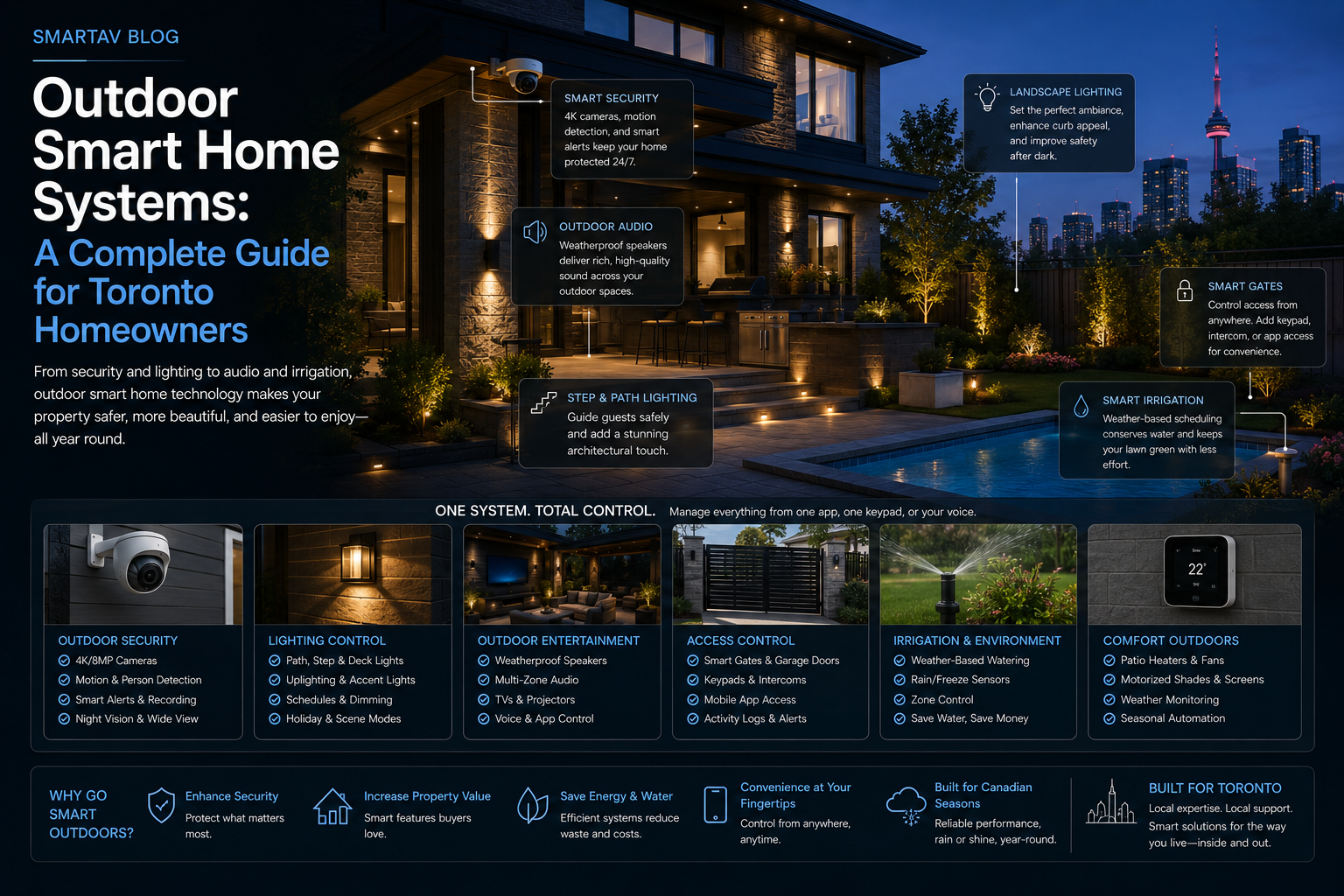
Outdoor living spaces in the GTA have a shorter usable season than the equipment installed in them needs to survive — a system has to perform through a humid July evening and still function correctly after sitting through a January deep freeze it was never actually used during. That reality shapes almost every decision in outdoor smart home design, from equipment selection to installation timing, more than most homeowners initially expect.
What Outdoor Smart Home Systems Include
A complete outdoor system typically spans four categories, each solving a different part of how a property gets used once the weather cooperates:
- Audio — architectural or landscape speakers extending music and ambiance to patios, pool areas, and gardens
- Lighting — automated landscape and architectural lighting for both ambiance and functional visibility
- Security and surveillance — cameras, sensors, and increasingly active deterrence covering exterior approaches and entry points
- Climate and comfort — outdoor heating, misting systems, and pergola or awning automation in more elaborate installations
Most projects don’t tackle all four simultaneously — a common and sensible approach is starting with lighting and audio for immediate lifestyle value, then adding security or comfort features in a later phase once the core outdoor space is established.
The sequencing worth planning for, regardless of which category comes first, is infrastructure: wiring, conduit, and equipment locations for later phases are dramatically cheaper to plan and rough in during an initial landscaping or installation project than to add afterward once a patio is finished and gardens are established. Even homeowners who only want lighting and audio installed immediately often benefit from having conduit run for future security cameras during the same excavation work, simply because the incremental cost of adding an empty conduit run is minor compared to trenching a finished lawn again later.
Outdoor Audio: Architectural and Invisible Speaker Systems
Outdoor audio has moved well past the visible rock-shaped speaker that used to define the category. Modern architectural speakers — in-ground, in-ceiling under a covered patio, or landscape-integrated — deliver genuinely high-fidelity sound while remaining visually unobtrusive, an important consideration for homeowners who’ve invested in professional landscape design and don’t want equipment competing with it visually.
→ Related: For a full breakdown of outdoor speaker types and where each performs best, see Outdoor Audio Systems: In-Ground vs In-Ceiling vs Landscape Speakers
Automated Landscape Lighting
Landscape lighting serves double duty — ambiance for evening entertaining and functional safety lighting for pathways, stairs, and entry points. Automated systems tie both purposes together: warm accent lighting for a dinner party scene, brighter functional lighting triggered by motion near entry points after dark, and scheduled dusk-to-dawn operation that adjusts automatically through the seasons as Toronto’s daylight hours shift dramatically between June and December.
Integrating exterior lighting into the same platform as interior lighting means a single “Away” or “Goodnight” scene can extend seamlessly outdoors — exterior lights following the same randomized away-schedule logic as interior lighting, rather than operating on a separate, disconnected system.
→ Related: See how this fits into a whole-home lighting design in Smart Lighting Automation: Complete Buyer’s Guide for Toronto Homes
Outdoor Security and Surveillance
Exterior cameras and sensors face different design considerations than indoor security — coverage typically needs to extend across a larger, less controlled area, and equipment has to withstand direct weather exposure year-round rather than the relatively stable conditions indoor devices operate in. AI-based detection remains just as valuable outdoors, distinguishing people and vehicles from the false triggers outdoor motion (wind-blown branches, passing animals, headlight glare) generates far more frequently than indoor environments do.
→ Related: For the full picture of modern surveillance technology, including active deterrence, see Video Surveillance for Toronto Homes: What to Look for in 2026
Weatherproofing for Canadian Climates
This is where outdoor equipment selection genuinely diverges from indoor, and it’s the single most common mistake we see in improperly specified outdoor systems: using equipment rated for occasional weather exposure rather than genuine four-season Canadian outdoor use. A speaker or camera marketed as “outdoor rated” in a milder climate’s product literature doesn’t automatically mean it’s tested for what a Toronto winter actually puts equipment through.
Temperature range matters more than most spec sheets emphasize. Equipment needs to reliably operate — or at minimum, safely survive without damage — across Toronto’s full range, from summer highs well into the 30s°C with high humidity through winter lows that regularly drop well below freezing, sometimes into deep-freeze conditions for extended periods.
IP ratings indicate actual weather resistance. An IP65 or higher rating indicates genuine protection against dust and water jets, appropriate for equipment with direct rain and snow exposure. Equipment rated only for “outdoor use” without a specific IP rating disclosed is worth questioning before installation, not after a failure.
Freeze-thaw cycling stresses equipment differently than constant cold. Toronto’s climate doesn’t just get cold — it cycles repeatedly between freezing and thawing throughout the winter, which stresses seals, housings, and mounting hardware more than a climate that simply stays cold consistently. Equipment genuinely tested for this kind of cycling, not just rated for a single cold-weather spec, holds up meaningfully better over a multi-year service life.
SmartAV note: We’ve replaced more outdoor equipment due to inadequate weatherproofing than due to genuine product failure — the equipment itself is usually fine; it was specified for a milder climate than Toronto actually delivers. Confirming genuine four-season Canadian outdoor ratings before installation avoids this entirely.
Integration With Your Indoor System
Outdoor systems deliver the most value when they extend an existing indoor automation platform rather than operating as a separate, disconnected system with its own app and controls. A Control4 or Crestron system that already manages indoor lighting, audio, and security can extend the same scenes, the same app, and the same voice control outdoors — “Entertaining” mode adjusting both indoor and outdoor lighting and audio together, for instance, rather than requiring separate management of two systems that happen to share a property.
Best Time to Install: Why Spring and Fall Are Ideal
Outdoor installation work depends on accessible ground and reasonable working conditions, which makes spring and fall the practical windows for most projects in the GTA. Spring installation means systems are ready for the full summer entertaining season; fall installation, while less common, allows landscaping and wiring work to be completed before ground freezes, positioning the system to be ready the following spring without racing the calendar during peak summer demand for installers.
Winter installation is possible for certain scopes (equipment mounted under existing covered structures, for instance) but frozen ground significantly limits any project requiring in-ground wiring or speaker installation.
What Outdoor Systems Typically Cost
Pricing depends heavily on which categories are included and the size of the outdoor space being covered.
| Project Scope | Typical Installed Cost (Toronto, 2026, CAD) |
|---|---|
| Single zone — patio audio or basic landscape lighting | $3,000–$8,000 |
| Multi-zone lighting and audio, single property | $10,000–$25,000 |
| Full outdoor system — audio, lighting, security, integrated with indoor | $25,000–$60,000+ |
These figures include weatherproof equipment, wiring, and professional installation and programming. Landscaping or hardscaping work required to accommodate wiring is typically quoted separately by a landscape contractor, though experienced integrators often coordinate directly with landscaping teams to sequence the work efficiently.
Frequently Asked Questions
How long does outdoor equipment typically last in Toronto’s climate?
Properly rated outdoor equipment — genuine four-season rated, not just “water-resistant” — typically performs reliably for 8-12 years or more, comparable to well-specified indoor equipment, provided it was correctly rated for Canadian outdoor conditions from the start.
Can outdoor speakers and lighting run on the same automation system as indoors?
Yes — this is the recommended approach for most projects. Extending an existing Control4, Crestron, or Lutron system outdoors avoids the complexity and inconvenience of managing separate indoor and outdoor systems independently.
Do I need to remove or store any outdoor equipment for winter?
Properly rated equipment is designed to remain installed and functional year-round, including through winter. Some homeowners choose to power down specific zones (a pool area speaker system, for instance) seasonally, but this is a preference rather than a requirement for equipment genuinely rated for Canadian conditions.
Is it worth starting with just one category — lighting or audio — rather than a full outdoor system?
Absolutely — starting with the category that delivers the most immediate value for how you actually use the space, then expanding over time, is a common and practical approach. The main consideration is planning wiring and infrastructure with future phases in mind, even if they’re not installed immediately.
How disruptive is outdoor installation to an established landscape?
This depends heavily on scope — surface-mounted lighting and equipment on existing structures is minimally disruptive, while in-ground speaker or extensive wiring work requires trenching that temporarily disturbs lawn or garden areas. Experienced installers minimize this where possible and can often route wiring along existing garden bed edges or under pathways rather than through established lawn areas.
Plan Your Outdoor System
SmartAV designs outdoor smart home systems built for genuine four-season Toronto conditions, from a single-zone audio upgrade to a full integrated outdoor living space.
📞 (416) 904-0504