
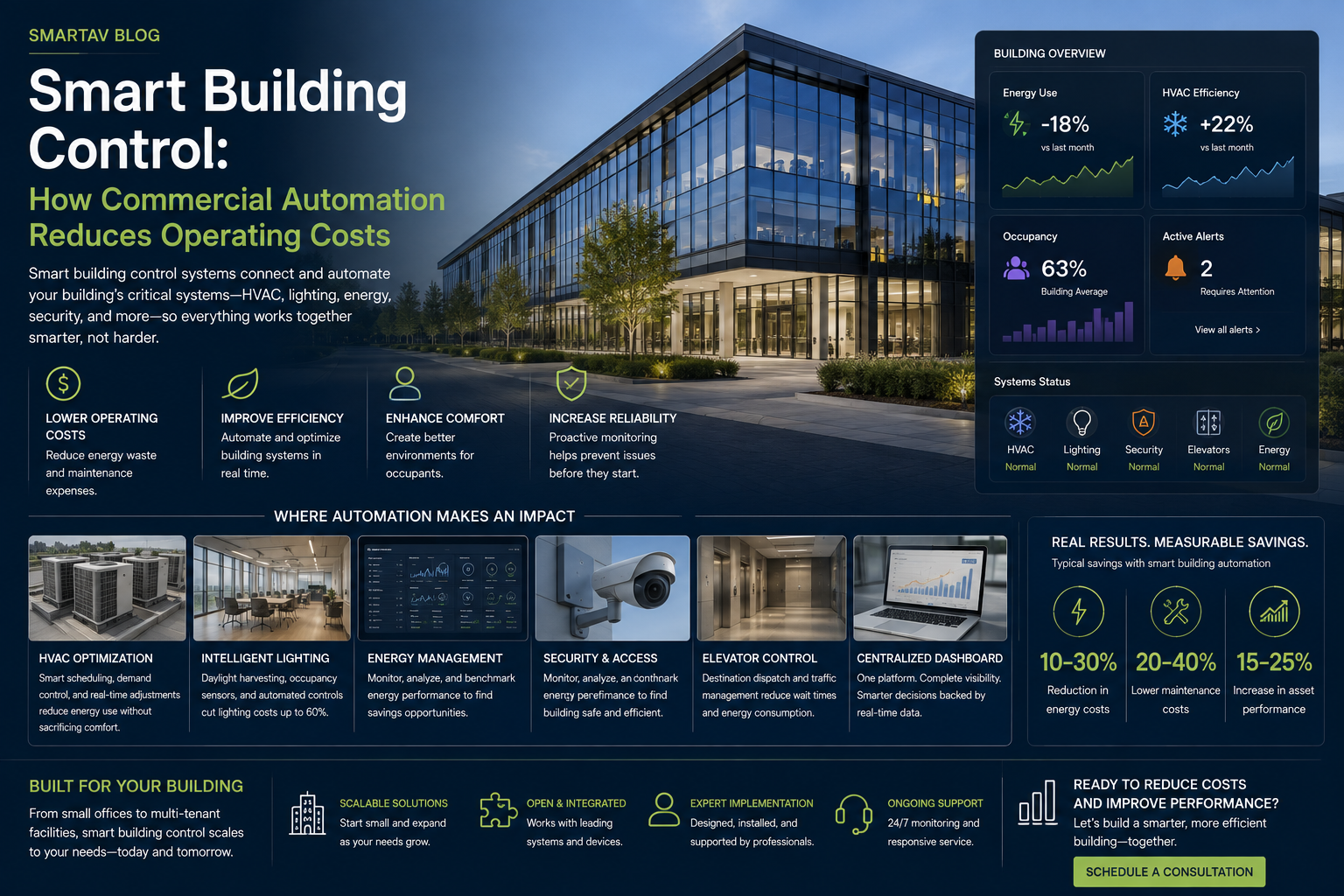
Commercial automation gets pitched constantly on abstract benefits — “efficiency,” “modernization,” “the future of work.” For a business evaluating whether it’s actually worth the investment, the more useful framing is operating cost: which specific systems, automated in which specific ways, produce a measurable reduction in what a building costs to run every month.
The ROI Case for Commercial Automation
Commercial automation projects tend to get evaluated more rigorously than residential ones, and rightly so — a business needs the numbers to work, not just the convenience story. The strongest ROI cases come from a combination of four categories: reduced energy consumption from lighting and HVAC that only run when spaces are actually occupied, reduced labour cost from automated processes that previously required manual attention, reduced liability and compliance risk from better access control and monitoring, and improved space utilization data that informs real estate decisions.
Not every building sees equal returns from every category — a retail space’s biggest opportunity often looks different from an office building’s, which looks different again from a warehouse. A retail space typically sees its largest gains from lighting and signage automation tied to store hours and foot traffic patterns; an office sees the biggest impact from occupancy-based HVAC and meeting room scheduling; a warehouse or industrial space often benefits most from zoned climate control and access logging across a large, security-sensitive footprint. Understanding which levers actually apply to a specific property is the first step before estimating realistic payback.
Lighting Automation With Occupancy Sensors
Commercial lighting left running in unoccupied spaces is one of the most consistent and easily quantified sources of waste in a typical building. Occupancy and vacancy sensors — which turn lighting on when a space is entered and off after a period of no detected motion — directly address this, and the technology has matured enough that false triggers (lights turning off while someone’s still in the room but not moving much) are largely a solved problem with modern sensor placement and sensitivity tuning.
Daylight harvesting adds a further layer: dimming artificial lighting automatically in spaces with adequate natural light, rather than running fixtures at full output regardless of how much sun is coming through the windows. Combined with occupancy sensing, this typically represents one of the fastest-payback automation investments a commercial building can make, since the underlying waste it addresses is both significant and easy to measure before and after.
Properly zoned lighting control also supports a more granular approach than simple on/off switching — individual zones within an open-plan office can operate independently based on that specific area’s occupancy, rather than an entire floor’s lighting being governed by whether anyone is present anywhere on it. This zone-level granularity is often where the largest incremental savings show up in buildings that already have basic occupancy sensing but haven’t refined zone boundaries to match how the space is actually used.
HVAC and Climate Scheduling
Heating and cooling unoccupied spaces — an office running full climate control over a weekend, a conference room conditioned to the same setpoint whether it’s booked or empty — represents a larger and often less visible source of waste than lighting, simply because HVAC energy costs don’t show up as obviously as a light left on.
Automated scheduling tied to actual occupancy patterns (calendar integration for meeting rooms, standard business-hours setbacks for general office space, and demand-based adjustments for spaces with variable use) reduces this waste directly. For buildings with zoned HVAC systems, automation can extend further — conditioning only the specific zones in active use rather than the entire floor uniformly.
One of the more underused opportunities in HVAC automation is meeting-room-specific control tied directly into the same calendar integration used for boardroom AV scheduling — a room set to a comfortable temperature only in the window immediately before and during a booked meeting, rather than maintained at that setpoint all day regardless of whether it’s occupied. For a building with a significant number of meeting or conference rooms, this narrow but frequently overlooked automation opportunity can add up to a meaningful share of total HVAC savings on its own.
Access Control and Security Automation
Beyond the security benefits covered elsewhere, access control automation carries a genuine operating cost dimension: eliminating the administrative burden of managing physical keys and fobs, and the liability exposure of not knowing exactly who had access to a space at a given time. For businesses with any compliance requirement around restricted-area access — server rooms, records storage, controlled inventory — automated access logging turns a manual, error-prone process into a searchable, audit-ready record.
The administrative time savings are easy to overlook but genuinely add up for businesses with regular staff turnover. Rekeying locks or reissuing physical fobs every time an employee leaves is a recurring cost in both hard dollars and staff time; deactivating a digital credential the moment HR processes a departure eliminates that recurring expense entirely, along with the security gap that exists in the interim while a physical rekey is scheduled and completed.
→ Related: For the full picture of what modern access control includes, see Access Control for Homes and Businesses: Beyond the Key Fob
Energy Monitoring and Reporting
A building automation system’s value compounds when it includes genuine energy monitoring, not just control — visibility into which systems, zones, and time periods are actually driving energy costs, rather than working from assumptions. This visibility does two things: it identifies where further automation or equipment upgrades would deliver the most value, and it provides the actual data needed to verify that automation investments are producing the savings they were expected to.
For larger commercial properties, energy reporting also increasingly supports sustainability reporting requirements and green building certifications, which carry their own value beyond the direct utility cost savings.
SmartAV note: Businesses often ask us to estimate savings before installation, and the honest answer is that the estimate is only as good as the building’s existing energy monitoring data. Buildings with little historical visibility into where energy is actually going benefit from a monitoring-first approach — measure before automating, then measure again after, to know what actually worked.
Crestron and Control4 for Commercial Buildings
Both platforms extend into commercial applications, though the choice typically follows the same logic as residential projects: Crestron’s commercial-grade heritage and custom-programming flexibility suit larger, more complex buildings and multi-tenant properties with sophisticated requirements, while Control4’s driver-based approach and lower relative cost suit smaller commercial spaces and single-tenant offices where extensive customization isn’t required.
→ Related: For the full breakdown of what drives Crestron’s cost and capability, see Crestron Home Automation: What It Is and Why It Costs More
Realistic Payback Expectations
Commercial automation ROI varies significantly by building type and starting point, but a few patterns hold consistently across most projects:
| Automation Category | Typical Payback Timeline | Primary Savings Driver |
|---|---|---|
| Lighting occupancy sensing | Fastest — often under 2 years | Direct energy reduction |
| HVAC scheduling automation | 2–4 years | Reduced conditioning of unoccupied space |
| Access control (labour/liability) | Variable — depends on incident cost avoidance | Administrative time, compliance risk reduction |
| Full building automation with monitoring | 3–6 years, property-dependent | Combined energy and operational efficiency |
Buildings starting from little to no existing automation typically see the fastest and most easily demonstrated returns, simply because the baseline waste being addressed is larger. Buildings that have already automated lighting or HVAC individually see smaller incremental returns from unifying those systems, though the operational and reporting benefits of a single coordinated platform still carry real value beyond the direct energy numbers.
SmartAV’s Commercial Clients
SmartAV designs commercial automation systems for offices, retail spaces, and multi-tenant properties across the GTA, from single-system upgrades (lighting occupancy sensing, for instance) to full building automation with energy monitoring and centralized access control.
Frequently Asked Questions
How long does a commercial automation project typically take to implement?
This varies significantly by building size and scope — a single-floor office lighting retrofit might take a week or two, while a full building automation deployment across multiple floors or tenants can take several months, often phased to minimize disruption to ongoing business operations.
Does commercial automation require replacing existing HVAC or lighting hardware?
Not always — automation controls can often be retrofitted onto existing HVAC and lighting systems, adding scheduling and sensor-based control without replacing the underlying equipment. Older or incompatible equipment may require upgrades to support full automation integration.
Is commercial automation only worth it for large buildings?
No — the ROI logic applies at smaller scales too, particularly for lighting occupancy sensing, which tends to have a fast payback regardless of building size. Larger, more complex automation deployments simply have more systems to coordinate, not a higher minimum threshold to be worthwhile.
How is commercial automation different from residential automation platforms?
The underlying technology overlaps significantly — both Crestron and Control4 extend into commercial applications — but commercial deployments typically prioritize multi-user management, compliance and audit logging, and integration with building management systems more heavily than residential projects do.
Can automation be rolled out in phases rather than all at once?
Yes, and phasing is common practice for larger buildings — starting with the category offering the fastest, most measurable payback (typically lighting occupancy sensing) and expanding into HVAC scheduling, access control, and full energy monitoring in subsequent phases as budget and priorities allow.
Get a Commercial Automation Assessment
SmartAV assesses commercial properties across Toronto to identify where automation delivers real, measurable operating cost reductions — not just convenience upgrades.
Get a commercial automation assessment →
📞 (416) 904-0504