
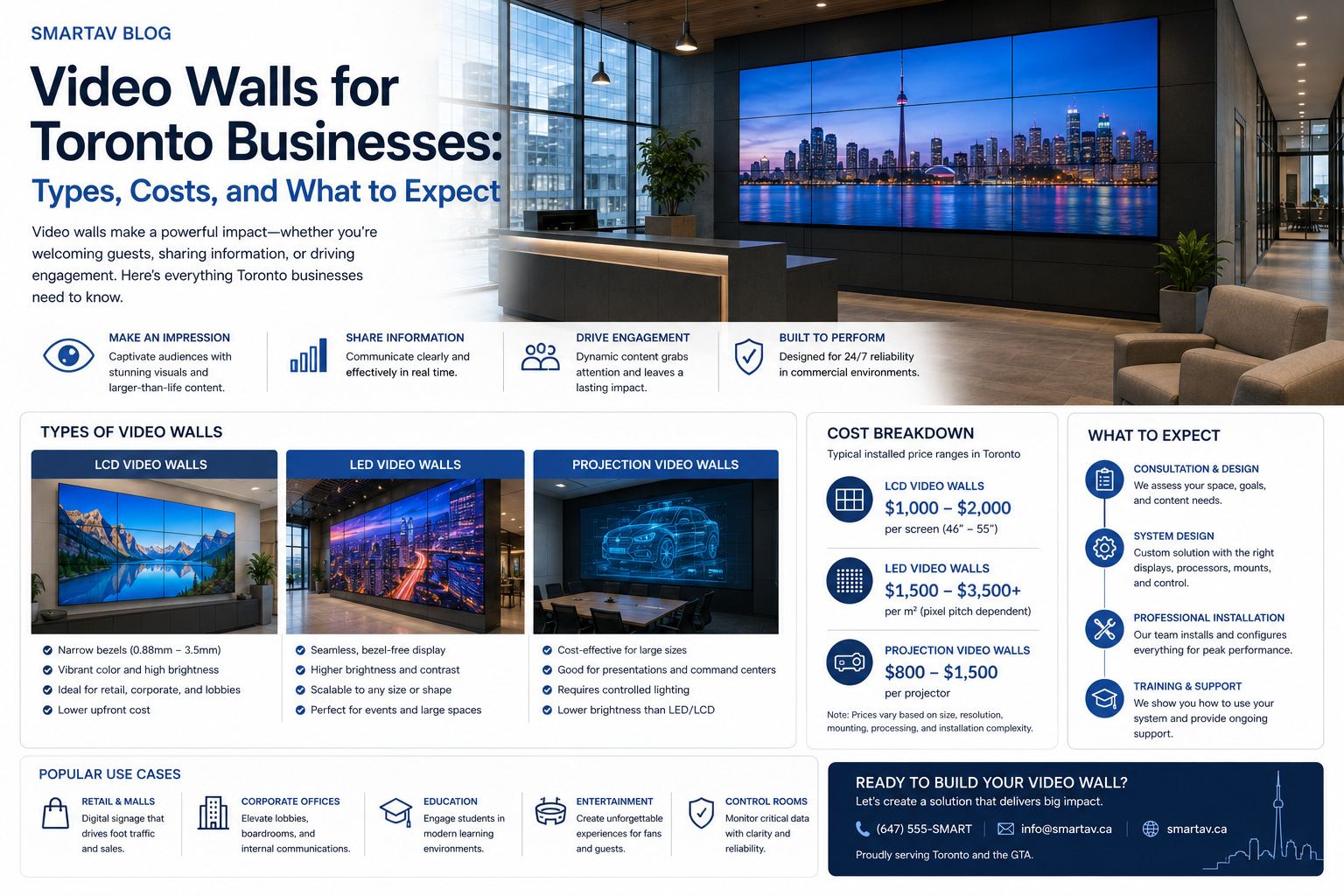
A video wall is one of the more visible investments a business makes in its physical space — a lobby, a retail floor, an event venue — which makes getting the technology choice right more consequential than most AV decisions. The core question almost every business ends up asking is the same one: LCD tile or direct-view LED? The answer depends less on budget alone than most people assume, and more on viewing distance and how the wall will actually be used.
What Is a Video Wall?
A video wall is a large-format display built from multiple individual panels or LED modules working together as one seamless (or near-seamless) image, controlled by a dedicated processor that manages content across the entire array. Unlike a single large TV, a video wall can scale to essentially any size and aspect ratio — a narrow vertical strip, an ultra-wide lobby feature, or a massive multi-story installation — by adding panels or modules rather than being limited to a single manufactured display size.
This scalability is the core reason businesses choose a video wall over an oversized single display in the first place: a manufactured TV or commercial display tops out at a fixed maximum size, while a video wall’s size is determined by how many panels or modules the space and budget allow — practically unlimited in either dimension, which is exactly what a large lobby, retail storefront, or event space frequently requires.
LCD Tile vs. Direct-View LED
LCD video walls use multiple LCD panels, each similar to a large commercial television, arranged in a grid and driven by a video wall processor. The panels are bezel-minimized (often under 1mm between visible image areas on premium models) but a seam is still technically present between tiles, visible at close viewing distances. LCD walls are generally the lower-cost option for a given size and deliver excellent image quality at typical viewing distances of 6 feet or more.
Direct-view LED walls use individual LED modules with no visible bezels or seams at all — the image is genuinely continuous across the entire wall, regardless of size. LED walls also achieve significantly higher brightness than LCD, making them the better choice for spaces with high ambient light (storefronts with large windows, outdoor-facing displays) where LCD would struggle to remain visible. The trade-off is cost — direct-view LED is meaningfully more expensive than LCD tile for a comparable size — and pixel pitch (the spacing between individual LEDs) needs to be matched to viewing distance, since a pitch suited to viewing from 15 feet away will show visible individual pixels at close range.
Pixel pitch is worth understanding in a bit more detail, since it’s the specification most directly tied to both image quality and cost. A finer pitch (smaller spacing between LEDs, such as 1.2mm or 1.5mm) delivers a sharper image at close viewing distances but costs significantly more per square foot than a coarser pitch (2.5mm or higher) intended for viewing from across a large lobby or event floor. Specifying a finer pitch than a space’s typical viewing distance actually requires is a common and avoidable way installations end up over budget without a corresponding improvement in perceived image quality.
| Factor | LCD Tile | Direct-View LED |
|---|---|---|
| Visible seams | Minimal but present | None — fully seamless |
| Brightness | Good, suited to controlled lighting | Excellent — works in high ambient light |
| Cost per square foot | Lower | Higher |
| Ideal viewing distance | 6+ feet | Varies by pixel pitch, often closer |
| Best for | Boardrooms, controlled-lighting lobbies | Storefronts, bright spaces, close-viewing installations |
Size and Configuration Options
Video walls are typically specified as a grid — a 2×2 configuration of four panels, a 3×3 of nine, and so on for LCD tile, while direct-view LED is specified more flexibly by total width and height in feet or meters, since individual LED modules can be combined into essentially any dimension. Non-rectangular configurations — an L-shaped wall following a building’s architecture, or a curved installation — are achievable with direct-view LED in ways that aren’t practical with rigid LCD panels.
Aspect ratio matters as much as raw size for content planning: a wall built for a standard 16:9 video content library behaves differently in terms of available content than an ultra-wide format built primarily for branding and ambient visuals, which is worth deciding before committing to a specific configuration rather than after.
Content Management Systems
The hardware is only half of a video wall installation — the content management system (CMS) is what actually determines how easy the wall is to use day to day. A well-chosen CMS allows non-technical staff to schedule content, update messaging, and manage multiple screens or zones without needing to call in a technician for routine changes.
Key CMS considerations include how content is scheduled (time-of-day, day-of-week, or event-triggered), whether the system supports multiple content zones within a single wall (a main video area alongside a scrolling ticker, for instance), and how remotely the system can be managed — many modern CMS platforms allow content updates from anywhere via a web portal, which matters for multi-location businesses managing several video walls from a central marketing team.
SmartAV note: We see businesses underinvest in the content management side more often than the display hardware. A beautiful video wall running the same static image for six months because updating it requires a service call isn’t delivering anywhere near its potential value — a well-chosen CMS is what keeps the investment actually working for the business.
Use Cases: Retail, Lobbies, Event Spaces, and Corporate
Retail — storefront and in-store video walls drive foot traffic and reinforce branding, typically prioritizing brightness (for storefront visibility through glass) and dynamic, frequently updated content over the highest possible resolution.
Corporate lobbies — often prioritize brand presence and a polished first impression over content frequency, running curated brand content, company updates, or ambient visuals suited to a controlled-lighting environment where LCD tile frequently makes the most sense.
Event spaces — need flexibility above all, supporting everything from live video feeds and presentations to branded content for different clients or events, often with direct-view LED’s seamless, high-brightness image being worth the added cost for a venue’s core selling point.
Corporate offices and boardrooms — smaller-scale video walls or large single displays supporting presentations, data visualization, and hybrid meeting content, typically prioritizing image quality and integration with the room’s broader AV system over raw brightness.
→ Related: For how video displays integrate into a broader meeting room system, see Boardroom AV Systems: What Modern Offices Actually Need in 2026
Total Installation Cost in Toronto
Video wall pricing varies enormously by technology, size, and configuration complexity.
| Project Scope | Typical Installed Cost (Toronto, 2026, CAD) |
|---|---|
| Small LCD tile wall (2×2, standard resolution) | $15,000–$35,000 |
| Mid-size LCD tile wall (3×3 or larger) | $35,000–$80,000 |
| Direct-view LED, small to mid-size | $60,000–$150,000 |
| Large-format direct-view LED (custom size/shape) | $150,000–$500,000+ |
These figures include panels or LED modules, mounting structure, video processing, content management system setup, and professional installation. Ongoing content management platform fees, where applicable, are typically billed separately as an annual or monthly subscription.
SmartAV’s Video Wall Projects
SmartAV designs and installs video walls for retail, corporate, and event spaces across Toronto, matching display technology and content management to how each space actually gets used — not defaulting to the most expensive option available.
Frequently Asked Questions
How long do video wall installations typically take?
Installation timelines vary by size and complexity, but a standard LCD tile wall typically takes 3–7 days including mounting, calibration, and content system setup. Large custom direct-view LED installations can take several weeks depending on structural requirements.
Do video walls require ongoing maintenance?
Yes, at a modest level — periodic cleaning, occasional panel or module calibration to maintain color and brightness uniformity, and content management system updates. LCD panels also have a rated lifespan for brightness degradation over time, similar to any large display technology, though quality commercial panels are built for years of continuous operation.
Can an existing video wall be expanded later?
For LCD tile walls, expansion generally requires matching the existing panel model, which may not be available years later — worth discussing with your installer if future expansion is a real possibility. Direct-view LED walls are generally easier to expand incrementally since modules are more standardized across a product line.
Is direct-view LED always better than LCD tile?
Not necessarily — for controlled-lighting environments viewed from a reasonable distance, LCD tile delivers excellent image quality at a meaningfully lower cost. Direct-view LED earns its premium specifically in high-ambient-light environments or where a completely seamless image at close range genuinely matters to the application.
How much does content creation cost on top of the hardware and CMS?
This varies enormously depending on whether content is a simple branded slideshow or custom-produced video content, and is generally quoted separately from the hardware installation. Many businesses start with a modest content library and expand it over time as they see what resonates with their audience, rather than committing to an expensive content production budget upfront.
Get a Video Wall Quote
SmartAV designs video wall installations for Toronto businesses, from a single lobby display to large-format custom LED installations.
📞 (416) 904-0504