
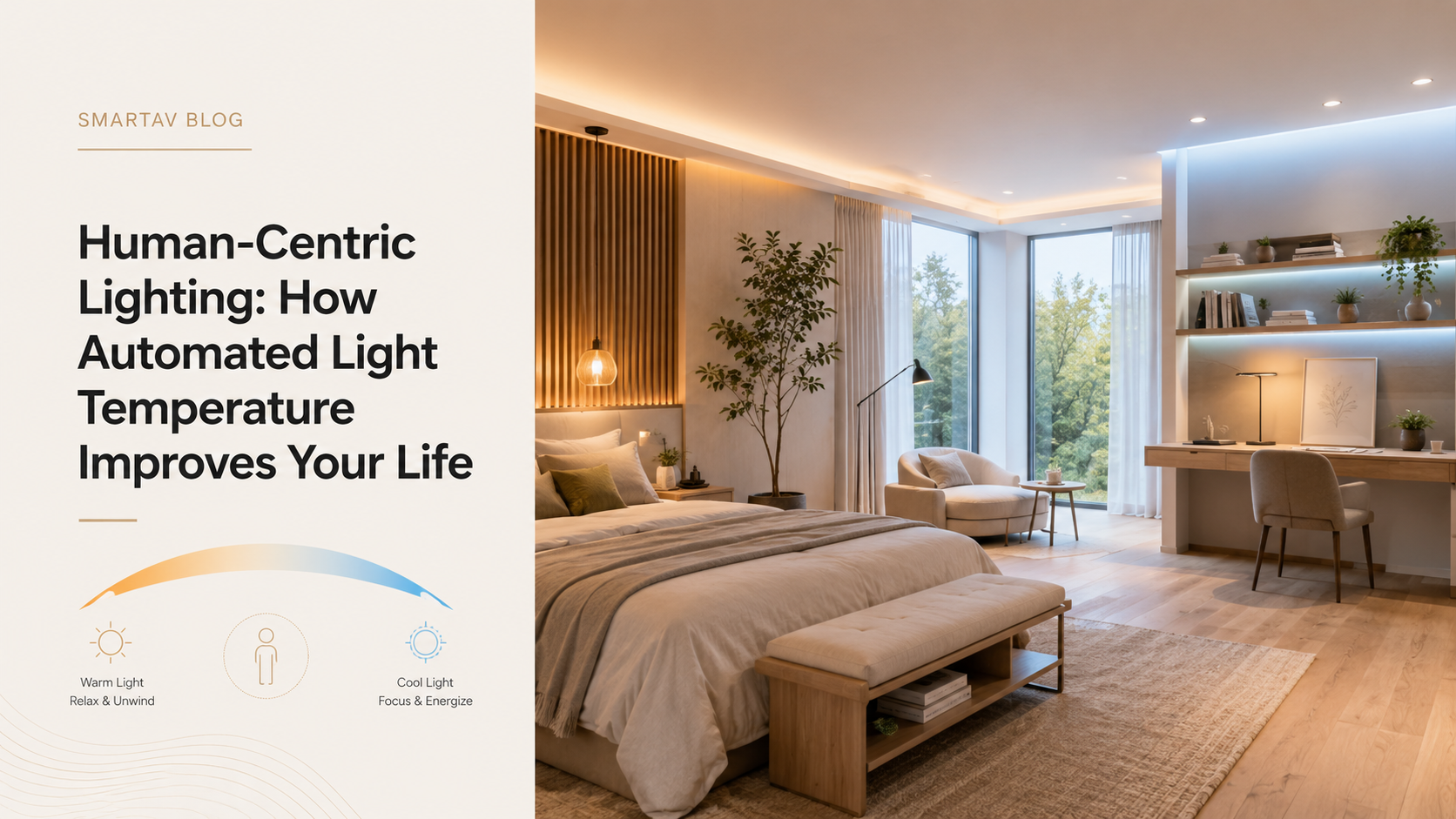
Most homes run the same lighting all day — the same warm-white glow at 7am as at 9pm, regardless of what the body actually needs at that hour. Human-centric lighting changes that by automating the color temperature and brightness of your home’s lighting to track a pattern closer to natural daylight. It’s one of the more overlooked features of a well-designed lighting system, and one of the most noticeable once it’s actually experienced.
What Is Human-Centric Lighting?
Human-centric lighting — also called circadian lighting — is an automated approach to lighting control that shifts color temperature and brightness throughout the day to support the body’s natural circadian rhythm. Rather than a single fixed setting, the light itself changes character: cooler and brighter through the morning and midday, gradually warming and dimming into the evening.
This isn’t a new concept — hospitals, schools, and commercial offices have used tunable lighting for years specifically because of its effects on alertness and wellbeing. What’s changed is that the technology has become practical and genuinely elegant for residential use, integrated into whole-home lighting systems rather than requiring separate specialized hardware.
How Light Temperature Affects Alertness and Sleep
The science behind this is well established: exposure to cooler, bluer light suppresses melatonin production and supports alertness, which is why daylight — particularly midday sun — keeps us feeling awake and focused. As natural light warms and dims toward evening, melatonin production begins naturally, supporting the body’s transition toward sleep.
Most artificial lighting doesn’t follow this pattern at all. A kitchen lit by the same 3000K bulbs at 7am and 9pm is working against, not with, the body’s natural cues — bright, warm light in the morning doesn’t support alertness the way cooler light does, and the same warm light in the evening is closer to what the body actually wants at that hour, just at the wrong brightness.
How Automated Lighting Schedules Work
A human-centric lighting system doesn’t require manual adjustment throughout the day — that’s the entire point. Once programmed, the system shifts color temperature and brightness automatically, typically tied to the home’s actual sunrise and sunset times rather than a fixed clock schedule, so the transitions stay aligned with the seasons.
A typical schedule looks something like this:
| Time of Day | Color Temperature | Brightness |
|---|---|---|
| Early morning (wake-up) | 4000–5000K, cool | Moderate, ramping up |
| Midday | 5000–6500K, cool-daylight | Full brightness |
| Late afternoon | 3500–4000K, neutral | Gradually dimming |
| Evening | 2700–3000K, warm | Dimmed, relaxed |
| Night | 2200–2700K, very warm | Low, minimal |
The shifts happen gradually and imperceptibly — nobody notices the lighting actively changing, they just notice that the space feels right for the time of day.
Because the schedule is tied to actual sunrise and sunset rather than fixed clock times, it adjusts automatically through the seasons — a Toronto winter with sunset at 4:45pm produces a meaningfully different evening lighting schedule than a summer evening with daylight past 8pm, and a properly configured system handles that shift without any manual reprogramming.
Lutron’s Approach to Circadian Lighting
Lutron’s whole-home platforms — RadioRA 3 and Homeworks QSX — both support tunable-white lighting control natively, allowing color temperature schedules to be built directly into the same system that handles scene control, shading, and scheduling.
Lutron Ketra: Purpose-Built for Human-Centric Lighting
For homeowners who want the deepest and most precise circadian lighting experience, Lutron’s Ketra product line was built specifically for this purpose. Ketra luminaires use a multi-channel LED design that reproduces natural daylight spectra with high accuracy — not just adjusting warm-to-cool temperature, but replicating the actual quality and rendering of natural light far more precisely than a standard tunable-white fixture.
Ketra fixtures integrate directly with Lutron’s control platforms, meaning a Ketra-lit room can be programmed into the same scenes and schedules as the rest of a Homeworks QSX or RadioRA 3 system — no separate app, no separate control layer. For primary bedrooms, home offices, and main living spaces where lighting quality matters most, Ketra represents the highest tier of what’s available in residential circadian lighting today.
SmartAV note: We typically recommend Ketra selectively — primary bedrooms, home offices, and kitchens see the most benefit — rather than specifying it throughout an entire home. Standard Lutron tunable-white fixtures deliver a strong circadian effect at a lower cost for secondary spaces.
→ Related: See the full Lutron product lineup in Lutron Lighting Control: Complete Guide for Toronto Homeowners
Real-World Scenes: Morning, Daytime, Evening, Night
Human-centric lighting works best when it’s built into the same scene architecture as the rest of a home’s lighting control, rather than treated as a separate feature:
- “Wake Up” — Cool, moderate-brightness light ramps on gradually in the bedroom and bathroom, supporting a natural transition to alertness rather than a jarring full-brightness switch-on
- “Work Day” — Home office lighting holds at a cooler, brighter setting through core working hours to support focus
- “Wind Down” — Living spaces gradually warm and dim through the evening, reinforcing the body’s natural transition toward sleep
- “Goodnight” — Minimal, very warm lighting for nighttime bathroom trips that won’t disrupt sleep the way a bright overhead light would
Who Benefits Most
While every household can benefit from better-aligned lighting, a few groups tend to notice the difference most clearly:
- People with irregular schedules — shift workers, frequent travelers, and anyone whose natural daylight exposure is inconsistent
- Home office workers — cooler daytime light supports focus in a way static warm lighting doesn’t
- Older adults — circadian disruption becomes more common with age, and consistent light cues can help reinforce a stable sleep-wake pattern
- Families with young children — predictable, gently dimming evening lighting can support more consistent bedtime routines
For a household with a mix of these needs — say, a home office worker with an inconsistent schedule and young children — a well-designed system doesn’t require choosing one priority over another. Different rooms can run different circadian profiles: a home office tuned for sustained daytime focus, a nursery tuned for a gentle, sleep-supportive evening wind-down, all managed from the same underlying schedule engine.
Part of a Bigger Lighting Picture
Human-centric lighting works best as one layer of a broader lighting automation system, not a standalone add-on. The same scenes and schedules that handle circadian shifts also typically manage brightness for entertaining, security, and everyday convenience — which is why it’s worth planning as part of a whole-home lighting design rather than retrofitting in isolation later.
→ Related: For the full picture of what a professionally designed lighting system includes, see Smart Lighting Automation: Complete Buyer’s Guide for Toronto Homes
Frequently Asked Questions
Do I need special bulbs for human-centric lighting?
Standard tunable-white LED fixtures, compatible with Lutron’s control systems, deliver a solid circadian effect. For the highest-fidelity experience, Lutron Ketra fixtures are purpose-built for this specifically and offer more accurate light quality throughout the color temperature range.
Can human-centric lighting be added to an existing Lutron system?
In most cases, yes — if your existing fixtures support tunable white output and your Lutron processor supports it, circadian schedules can be programmed in without replacing the whole system. Older single-temperature LED installations may need fixture upgrades in key rooms.
Is this the same as just dimming lights in the evening?
No — dimming alone reduces brightness but doesn’t change color temperature. Human-centric lighting shifts both brightness and color temperature together, which is what actually produces the circadian effect; dimming warm light further doesn’t replicate the alerting quality of cooler daytime light.
Does human-centric lighting cost significantly more than standard lighting control?
Tunable-white fixtures cost somewhat more than single-temperature LEDs, and Ketra sits at a premium tier above standard tunable-white options. For most homes, a mixed approach — Ketra in a few key rooms, standard tunable-white elsewhere — balances cost and benefit well.
Add Circadian Lighting to Your Home
SmartAV designs human-centric lighting into new and existing Lutron systems across Toronto and the GTA, from standard tunable-white installations to full Lutron Ketra integrations.
Add circadian lighting to your home →
📞 (416) 904-0504