
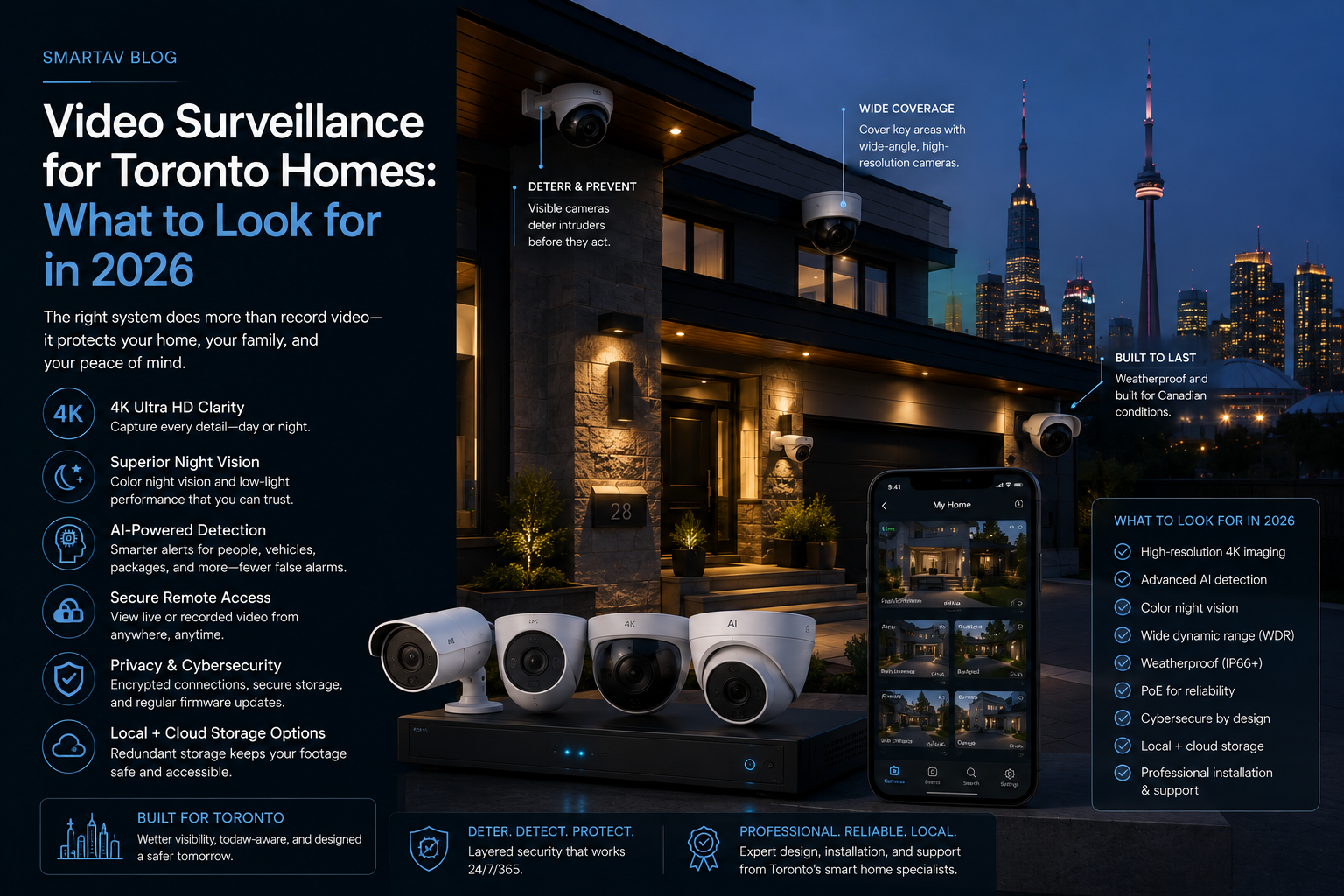
Camera technology has changed enough in the past few years that advice from even three or four years ago is genuinely outdated. AI-based detection is now standard rather than a premium feature, storage options have expanded, and a newer category — active deterrence — has moved surveillance from purely reactive recording toward systems that can intervene in real time. Here’s what actually matters when specifying a system in 2026, and where the meaningful differences between options actually lie versus where they’re mostly marketing.
Consumer Cameras vs. Professional Surveillance
The gap between a $150 retail camera and a professionally specified surveillance system isn’t really about brand prestige — it comes down to a handful of concrete differences: sensor quality and low-light performance, field-of-view accuracy for the specific area being covered, power and connectivity reliability, and how the footage is actually stored and retrieved when you need it.
Consumer cameras are designed to be easy to self-install anywhere, which means compromises on placement, power source, and often storage (cloud-only, with subscription fees for anything beyond a few days of retention). Professional systems are designed around the property first — coverage planned deliberately, power and data run to the ideal mounting location rather than wherever a battery happens to reach Wi-Fi.
AI Object Detection: Why It Eliminates False Alerts
Modern AI-based detection identifies what’s actually in frame — a person, a vehicle, an animal, a package — rather than triggering on any pixel change the way older motion-based systems did. This single feature accounts for most of the practical improvement in camera systems over the past several years: a camera that only alerts on relevant events is a camera people actually pay attention to, rather than one that gets muted after a week of irrelevant notifications.
Beyond basic categorization, current-generation systems can be configured with specific rules — alert only when a person enters a defined zone (a driveway, not the sidewalk beyond it), ignore vehicles entirely on a residential camera facing the street, or flag only after-hours activity in a commercial application. This level of configuration is what separates a system that’s actually useful day to day from one that’s technically capable but practically ignored.
Key Specs: Resolution, Field of View, and Night Vision
Resolution. 4K has become the practical standard for professionally installed cameras, providing enough detail to identify faces or license plates at a reasonable distance — a meaningful difference from older 1080p systems where footage often wasn’t clear enough to be useful for identification after the fact.
Field of view. Wider isn’t always better. A camera with too wide a field of view captures more area but at lower effective resolution per square foot, which can mean less usable detail on the specific zone that actually matters (a front door, a driveway entrance) compared to a camera specified with the right field of view for that particular location.
Night vision. Infrared night vision remains standard, but the meaningful differentiator in 2026 is color night vision — using ambient or supplemental light sources to capture usable color footage in low light rather than the grainy black-and-white image traditional IR produces. For identifying clothing color or vehicle color at night, this is a genuinely useful upgrade over older infrared-only systems.
Indoor vs. Outdoor Cameras
Outdoor cameras need weatherproofing rated for Toronto’s full climate range — reliable operation from summer humidity through winter cold, with housing that resists condensation and lens fogging during temperature swings. Indoor cameras have more flexibility in form factor and typically prioritize discretion and coverage of specific interior zones (entryways, main living areas) over the ruggedness outdoor placement demands.
A common design mistake is treating indoor and outdoor cameras as interchangeable — an indoor-rated camera mounted outside, even under an eave, is prone to premature failure from moisture and temperature cycling that a properly rated outdoor camera is built to handle. This is a particularly common issue in Toronto specifically, where the swing between summer humidity and winter cold puts more stress on improperly rated equipment than milder climates do.
How Footage Is Stored: Local vs. Cloud vs. Hybrid
Local storage (an on-site NVR — network video recorder) keeps footage on your property, with no ongoing subscription cost and no dependency on internet connectivity for recording to continue. The trade-off is that footage is only as safe as the physical hardware storing it — a stolen or damaged NVR can mean lost footage.
Cloud storage backs footage up off-site automatically, protecting it from local hardware failure or theft, but typically comes with an ongoing subscription cost and depends on a reliable internet connection to upload continuously.
Hybrid storage — recording locally with cloud backup of key events or clips — has become the practical standard for professionally installed systems in 2026, combining the reliability of local recording with the protection of an off-site copy, without the full cost of continuous cloud storage for every camera.
For most homeowners, the right choice comes down to a simple question: what’s the actual failure scenario you’re protecting against? If it’s a thief who might steal or damage visible equipment, cloud backup of key events matters more than local storage capacity. If it’s primarily about avoiding ongoing subscription costs and you’re comfortable with the (fairly low) risk of hardware failure or theft, local-only storage remains a reasonable, cost-effective choice.
Active Deterrence: AI Detection, Sirens, and Strobes
This is the most significant shift in residential surveillance technology in recent years, and it changes what a camera system is actually for. Traditional cameras — even AI-enhanced ones — are fundamentally reactive: they record an event and alert you after it’s already happening. Active deterrence adds a layer that can intervene in real time.
How it works. When AI detection identifies a person in a restricted zone — someone lingering near a side door after dark, for instance, rather than simply walking past on the sidewalk — the system can automatically trigger a response: a bright strobe light, an audible siren or verbal warning, or both, before anything escalates further.
Why this matters for prevention, not just documentation. A recorded break-in gives you evidence after the fact. An active deterrence system aims to prevent the break-in from happening at all — the sudden light and sound frequently interrupts an incident in progress, since most opportunistic intrusions rely on the assumption that no one is watching or responding in real time.
Where it’s most effective. Active deterrence tends to deliver the most value at secondary entry points and less-visible areas of a property — side and rear entrances, detached garages, backyard access points — locations that are attractive specifically because they’re less likely to be noticed by a passerby or neighbour.
From the field: We’re increasingly specifying active deterrence on side and rear entrances specifically, rather than the front of the property, which is typically already the most visible and least attractive target. The technology delivers the most value where visibility is naturally lowest.
What Surveillance With Active Deterrence Costs
Pricing depends heavily on camera count, coverage complexity, and whether active deterrence hardware is included at some or all locations.
| System Scope | Typical Installed Cost (Toronto, 2026, CAD) |
|---|---|
| Basic coverage — 4–6 cameras, AI detection, no deterrence | $4,000–$9,000 |
| Mid-size system — 6–10 cameras, hybrid storage, 1–2 deterrence points | $10,000–$20,000 |
| Full property coverage with deterrence at multiple entry points | $20,000–$45,000+ |
These figures include cameras, NVR or hybrid storage setup, AI detection configuration, and installation labour. Monitoring services, where added, are typically billed separately as an ongoing monthly cost.
Integration With Your Smart Home
Surveillance performs best as part of a coordinated system rather than a standalone feature. Camera detection events can trigger exterior lighting, notify a monitoring center, or feed into an access control system’s decision on whether to unlock a door for a recognized visitor — the kind of coordination that turns individual cameras into a genuinely integrated security posture rather than a collection of separate recording devices.
→ Related: For the full picture of what a coordinated security system includes beyond cameras, see Smart Home Security Systems: What Integrators Offer That DIY Can’t
→ Related: For how surveillance works alongside access control specifically, see Access Control for Homes and Businesses: Beyond the Key Fob
SmartAV’s Surveillance Installations
SmartAV designs and installs professional surveillance systems across Toronto and the GTA, including active deterrence configurations for properties where prevention — not just documentation — is the priority.
Frequently Asked Questions
Is active deterrence overkill for a typical residential property?
Not necessarily — it’s most valuable at less-visible entry points regardless of property size or value, since the underlying logic (opportunistic intrusions favor spots where no one seems to be watching) applies broadly. It’s worth discussing with an installer based on your property’s specific layout rather than assuming it’s only for high-value estates.
Do active deterrence systems risk false triggers on family members or pets?
Properly configured systems use zone-specific rules and person/vehicle detection to minimize this — a pet triggering a strobe light is a configuration issue, not an inherent limitation of the technology, and a professional installer tunes detection zones and sensitivity specifically to avoid this.
How much video history should I keep?
This depends on your storage approach and specific needs, but 14–30 days of retention is a common baseline for hybrid systems, balancing storage cost against having enough history to review an incident that isn’t noticed immediately.
Can I add active deterrence to an existing camera system?
In many cases, yes — if your existing cameras support AI detection and zone configuration, compatible sirens and strobes can often be integrated without replacing the full camera system. Older, non-AI-capable cameras typically need to be upgraded to support this level of automated response.
Are there legal considerations for sirens or strobe lights aimed at deterring intruders?
Generally, professionally installed deterrence systems are designed to comply with local noise and lighting bylaws, using time-limited alerts rather than continuous alarms. It’s worth discussing specific configuration with your installer, particularly for properties close to neighbouring homes where light or sound spillover could be a consideration.
Get a Surveillance System Quote
SmartAV designs surveillance systems for Toronto homes and businesses, from straightforward camera coverage to full active deterrence configurations.
Get a surveillance system quote →
📞 (416) 904-0504