
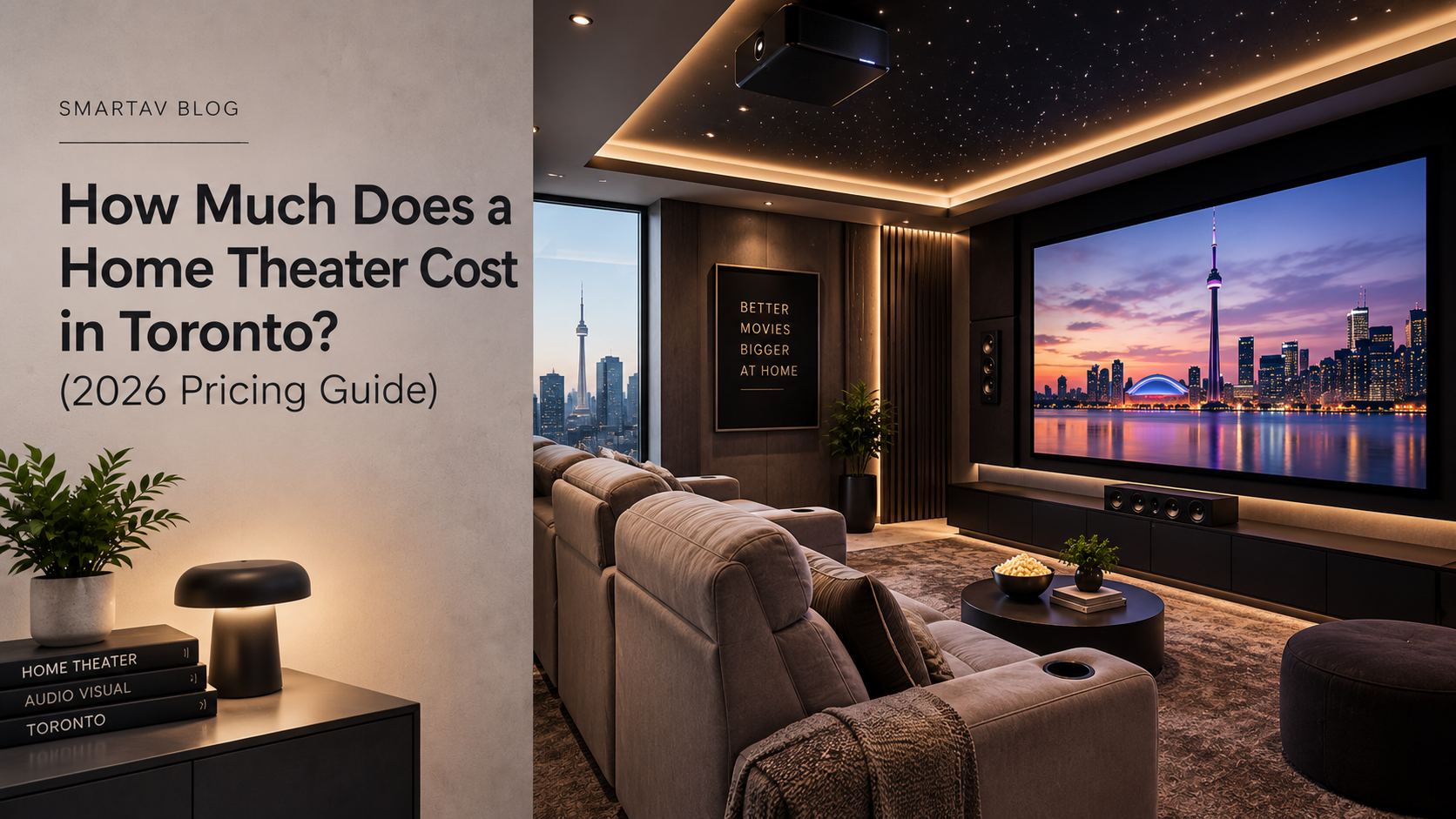
Home theater pricing varies more than almost any other category of smart home project — a well-executed room can run anywhere from $15,000 to well over $150,000, and the difference isn’t marketing markup. It’s genuinely different scopes of work: a basic display-and-speakers upgrade versus a fully engineered, acoustically treated cinema are two different projects that happen to share a category name. This guide breaks down what drives the cost at each tier, so you can budget realistically before getting quotes.
What Drives Home Theater Cost
Five factors account for most of the price variation between projects:
- Display technology — a large-format TV versus a 4K laser projector with a motorized screen carries a significant cost difference, and scales differently as size increases
- Acoustic treatment — from none at all to a fully custom-treated room with fabric-wrapped panels integrated into the design
- Speaker configuration — a basic 5.1 system versus a full 7.1.4 Dolby Atmos build-out with in-ceiling speakers
- Seating and room construction — pre-built furniture versus custom tiered risers and dedicated theater seating
- Automation integration — a universal remote versus full one-touch scene control tied into a whole-home Control4 or Crestron system
→ Related: For the full design process behind these decisions, see How to Design a Home Theater Room: A Complete Guide for Toronto Homeowners
Entry-Level Theater: $15,000–$30,000
An entry-level theater delivers a genuinely satisfying step up from a living room TV setup, typically in a finished or semi-finished basement space:
- 75–85″ large-format TV or an entry-level 4K laser projector with a fixed screen
- 5.1 or basic 5.1.2 Atmos audio system
- Light acoustic treatment — first-reflection panels and basic bass trapping
- Pre-built theater seating (not custom-built risers)
- Basic automation — a universal remote or entry-level app control, not full whole-home integration
This tier suits homeowners who want a clear step up from a standard living room setup without a full room build-out. It’s also a common starting point for homeowners planning a phased approach — installing solid infrastructure and a capable core system now, with room to add acoustic treatment, upgraded seating, or a display upgrade later without needing to redo the underlying wiring.
Mid-Range Theater: $30,000–$75,000
This is where most dedicated GTA home theaters land, and it represents the point where the room starts to feel like a genuine cinema rather than an upgraded media room:
- Mid-range to premium 4K laser projector with an acoustic-transparent motorized screen, or a large 85–98″ TV
- Full 7.1.4 Dolby Atmos with true in-ceiling height speakers
- Comprehensive acoustic treatment — first reflections, bass trapping, and rear-wall diffusion
- Tiered seating with proper riser construction for multi-row layouts
- Full automation integration — one-touch scene control tied into the room’s Control4 or Crestron system
→ Related: See how the projector-versus-TV decision affects this budget range in 4K Laser Projector vs Large Format TV: Which Is Best for Your Home Theater?
Luxury Dedicated Cinema: $75,000–$150,000+
At the top tier, cost is driven less by any single component and more by the level of custom design and finish carried throughout the entire room:
- Premium laser projection with a large motorized acoustic-transparent screen, professionally calibrated
- Elaborate Atmos configurations (9.1.6 or larger) with precision speaker placement
- Fully custom acoustic engineering — architecturally integrated treatment rather than visible panels
- Custom-built tiered seating, often with premium materials and integrated lighting
- Deep integration with a whole-home Crestron system, including custom finishes on touchscreens and keypads
Projects at this level are typically part of a larger new-construction or full-home renovation, where the theater room is planned alongside the rest of the home’s architecture rather than retrofitted into existing space. Structural elements like ceiling height, room shape, and wall construction are often decided with the theater’s acoustic requirements in mind from the earliest design phase, rather than working around constraints imposed by an existing basement layout.
→ Related: For a deeper look at Dolby Atmos configuration options across these tiers, see Dolby Atmos Home Theater: What It Is and How to Get It Right
New Build vs. Retrofit: Why the Same Room Costs Differently
The tiers above assume a room that’s already framed and reasonably accessible. The same specification costs meaningfully more as a retrofit into a finished basement than it does planned into new construction, for the same reason this pattern holds across every category of home automation: running wiring, adding structural support for acoustic treatment, and modifying HVAC or electrical after walls are finished all cost more than planning them in from the start.
For homeowners renovating or building new, looping in a home theater designer during the framing stage — even before finalizing a full equipment budget — typically saves a meaningful percentage of total project cost compared to treating the theater as a separate project after construction wraps up.
Cost Summary by Tier
| Tier | Typical Cost (CAD) | Best For |
|---|---|---|
| Entry-level | $15,000–$30,000 | Basement upgrade, casual movie nights |
| Mid-range | $30,000–$75,000 | Dedicated theater rooms, most GTA projects |
| Luxury dedicated cinema | $75,000–$150,000+ | New builds, full architectural integration |
Hidden Costs Most Installers Don’t Mention
A few line items catch homeowners off guard when they aren’t flagged upfront:
Electrical and structural prep. Dedicated circuits for equipment, proper ventilation for equipment racks, and any structural work needed for tiered seating or acoustic treatment aren’t always included in an initial equipment quote.
Room construction and finishing. If the room isn’t already framed and finished, drywall, flooring, and any soundproofing between the theater and adjacent rooms adds meaningfully to project cost — and is sometimes handled by a separate contractor rather than the AV integrator.
Calibration and commissioning. Professional audio and video calibration — tuning speaker levels, display settings, and automation programming specifically for the finished room — is sometimes quoted separately from equipment and installation labour. Confirm whether it’s included before comparing quotes.
Ongoing service. Firmware updates, seasonal calibration checks, and troubleshooting support are sometimes bundled into an initial warranty period and billed separately afterward. Ask what’s covered and for how long.
SmartAV note: The quotes that come in noticeably lower than others are almost always missing one of the items above, not offering the same scope at a better price. We provide itemized quotes specifically so homeowners can compare scope, not just a bottom-line number.
SmartAV’s Installation Process and Warranty
Every SmartAV home theater project starts with an in-home consultation and room assessment, followed by a detailed design proposal covering display, audio, acoustic treatment, and automation before any equipment is ordered. Installation includes full calibration and commissioning in the finished space, a walkthrough of the system’s controls, and our standard parts and labour warranty.
Frequently Asked Questions
What’s the single biggest cost driver in a home theater budget?
Acoustic treatment and speaker configuration typically account for more of the cost difference between tiers than the display itself — a common misconception is that upgrading the projector or TV is where the money should go first.
Can I build a home theater in phases to spread out the cost?
Yes, though it’s worth planning the full design upfront even if installation happens in stages — wiring, acoustic treatment locations, and seating layout are much harder to change after the fact than to plan correctly from the start, even if some equipment is added later.
Does the cost include the room’s construction, or just the AV equipment?
This varies by quote — some integrators handle equipment and installation only, while others coordinate the full room build including electrical, drywall, and seating. Confirm scope clearly before comparing quotes across different companies.
How long does a mid-range home theater project take from start to finish?
For an existing finished room, a mid-range theater installation typically takes 1–2 weeks from equipment delivery through calibration. Projects requiring room construction or renovation add significant time depending on the scope of that work.
Get a Custom Home Theater Quote
SmartAV provides detailed, itemized home theater quotes for Toronto homeowners at every budget tier, from entry-level upgrades to full luxury cinema builds.
Get a custom home theater quote →
📞 (416) 904-0504